The
Seventh-day Adventist Evangelical Conferences
of 1955 - 1956
by
Adventist Laymen's Foundation
,
Vol. V, p.
p
1 -- A WORD OF
EXPLANATION -- In
this Brochure, we have brought together all the presently
available source documents involving the Seventh-day Adventist
Evangelical Conferences during 1955-1956. These documents
are from the pens of some of the participants - on the part
of the Evangelicals, major participants,
Donald Grey Barnhouse and Walter R. Martin - and on the
part of the Seventh-day Adventists, the chairman of the
conferences, T. E. Unruh.
It must be noted that the observations
and evaluations of the conferences on the part of the Evangelcicals
were written immediately at the conclusion of the dialogues,
while the summation from the Adventist viewpoint did not
come till twenty years later in 1977, and written as an
historical postscript. In fact it must be remembered that
the rank and file of the Seventh-day Adventist Church, including
most of its ministry at the time, did not know who all were
involved in these conferences, nor the primary author of
the book resulting from these dialogues - Questions on
Doctrine - till the article appeared in Adventist
Heritage* written by T. E. Unruh.
There remains - still out of
the reach of research - the original answers given by the
Adventist conferees to Barnhouse and Martin. The book -
Questions on Doctrine - while purporting to be those
answers, is not, but is rather a revision of what was given
to those men. Because of this - and so far no evidence has
been produced to nullify the conclusion - we must conclude
that what Walter Martin and Donald G. Barnhouse have written
is an accurate statement of what the Adventist conferees
did say to these men, and what the original answers did
read as given to them. A careful evaluation of what T. E.
Unruh has written reveals that the highest levels of the
Adventist hierarchy were involved in the denial of basic
historic Adventist Christology. The list of names reads
like a Who's Who of the executive officers of the General
Conference at that time. (See p. 41, Adventist Heritage
article)
Although the book - Questions
on Doctrine - is not being reprinted, and is no longer
available at Adventist Book Centers, the follow-up book
- Movement of Destiny - authored by the primary writer
of Questions on Doctrine, is still being promoted.
Movement of Destiny teaches the same heresies in
Christology as did Questions on Doctrine, and bears
the nihil obstat of the present president of the General
Conference, Neal C. Wilson, and the imprimatur of the previous
"first minister" of the Church, Robert H. Pierson.
In fact the Statement of Beliefs voted by the 1980 General
Conference reflects these same deviations from the historic
teachings of the Church in the areas of the Incarnation
and the Atonement. This makes it even more important that
we understand what did take place during these Seventh-day
Adventist Evangelical Conferences of 1955-1956. The present
theological crisis in the Church is not something that happened
over night, nor is it the work of one man, but its roots
go back to the betrayal of the trust placed in men who were
supposed to stand "as guardians of the spiritual interests"
of God's professed people. (See Testimonies For the Church,
Vol. V, p. 211)
* -- Adventist Heritage,
Vol 4, #2, pp. 35-46. Being reproduced by permission.
p 2 -- The
Adventist Heritage, Vol. 4, No. 2, 1977 - The Seventh-day
Adventist Evangelical Conferences of 1955-1956 by
T. E. Unruh (Now
living in Grand Terrace, California, T. E. Unruh is a retired
minister. When the events described here took place, Unruh
was president of the East Pennsylvania Conference.)
-- A series of
conferences between Seventh-day Adventist and Evangelical
leaders, begun in the spring in 1955 and running into the
summer of 1956, led to the publication of two books: the
first, Seventh-dayAdventists Answer Questions on Doctrine;
the second, The Truth About Seventh-day Adventism.The
first is a definitive statement of contemporary Adventist
belief, established on a broad international consensus of
church leaders and prepared for publication by a representative
committee appointed by the officers of the General Conference
of Seventh-day Adventists. The second work, by Walter R.
Martin, a leading expert on American cults, defines and
examines Seventh-day Adventist doctrines, using the first
work as source and authority. In his book Martin removed
the Seventh-day Adventist church from his list of non-Christian
cults and acknowledged that all whose beliefs followed the
Questions on Doctrine should be counted members of
the Body of Christ (the Christian church in the Evangelical
definition) and therefore his brethren. While some Adventist
and non-Adventist dissidents have been vociferous in their
denunciation of the Adventist definitions and the Evangelical
evaluation, in retrospect the conferences improved the understanding
and appreciation of the Seventh-day Adventist church on
the part of many Evangelical leaders, and likewise warmed
many Adventist leaders toward the Evangelicals. It was a
time when the gates between sheepfolds stood open.
There
was no thought of precipitating anything of such historic
consequence when I wrote a letter on November 28, 1949,
commending Dr. Donald Grey Barnhouse for his radio sermons
on righteousness by faith based on the book of Romans. At
the time, Dr. Barnhouse was a popular radio preacher, minister
of the Tenth Presbyterian Church of Philadelphia, Pennsylvania,
author of a number of Evangelical books, and founder and
senior editor of the influential Eternity magazine.
I was the president of the East Pennsylvania Conference,
with headquarters in Reading.
In
his reply to my letter Barnhouse expressed astonishment
that an Adventist clergyman would commend him for preaching
righteousness by faith, since in his opinion it was a well
known fact that Seventh-day Adventists believed in righteousness
by works. He went on to state that since boyhood he had
been familiar with Adventists and their teachings, and that
in his opinion their views about the nature and work of
Christ were Satanic and dangerous. He concluded by inviting
this strange Adventist to have lunch with him.
We
did not then get together for lunch, but we did correspond
for a time. I returned a soft answer
p 3 --
 |
| Donald
Grey Barnhouse, radio pastor and editor of ETERNITY
magazine, put Martin in touch with T. E. Unruh, because
of Unruh's earlier exchanges with Barnhouse. |
Though
his first attempts at improving Barnhouse's understanding
of Adventism resulted in further criticism, author T.
E. Unruh had established that Adventists want to be
understood. This provided an opening for future dialogue. |
to
the first letter from Barnhouse and sent him a copy of Steps
to Christ, at the same time affirming the evangelical
character of Adventists doctrine. I thought we had an agreement
that Barnhouse would publish no further criticism of Adventists
before there was further contact and clarification. However,
in Eternity for June 1950, he sharply criticized
Steps to Christ and its author. After that, I saw
no point in continuing the correspondence.
The
Barhhouse article was entitled, "Spiritual Discernment,
or How to Read Religious Books." It illustrated the
difficulty that conservative Christians sometimes have in
understanding one another. Here a man of great spiritual
stature, a bold crusader for truth, revealed his prejudice
against Adventism and Ellen G. White, whom he erroneously
called, "founder of the cult.'' Concerning the first
chapter of Steps to Christ, entitled "God's
Love for Man." Barnhouse charged that so much emphasis
on God's love neutralize His justice and that extending
that love to unregenerate man smacked of the universalism
characteristic of the writings of the cult. He quoted a
number of statements which he called half truths introducing
Satanic error, like a worm on a hook, "the first bite
is all worm, the second bite is all hook. That is the way
the Devil works." Yet this man came to respect Ellen
White as a sincere Christian and a great spiritual leader
and to acknowledge that Seventh-day Adventists were his
brethren in Christ.
In
the spring of 1955, almost six years after my correspondence
with Dr. Barnhouse began, I heard from Walter R. Martin,
who had seen our correspondence and who asked for face-to-face
contact with representative Seventh-day Adventists. Martin
had written a chapter critical of Adventism in his Rise
of the Cults and now wanted to talk with Adventists
before doing further writing on the subject of our doctrines.
Walter
Martin had come to the attention of Dr. Barnhouse when the
former was in his early twenties, a graduate student in
the history of
p 4 --
|
|
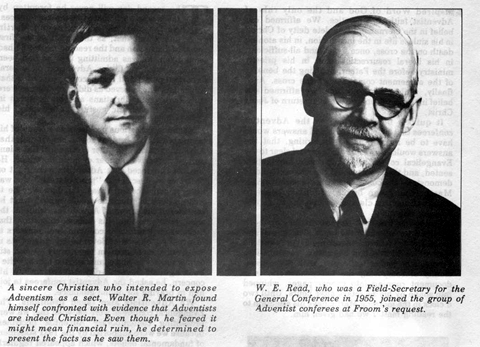
| A sincere Christian who
intended to expose Adventism as a sect, Walter R. Martin
found himself confronted with evidence that Adventists
are indeed Christian. Even though he feared it might
mean financial ruin, he determined to present the facts
as he saw them. |
W. E. Read, who was a Field-Secretary
for the General Conference in 1955, joined the group
of Adventist conferees at Froom's request. |
American
religion at New York University. By 1955 Martin had to his
credit several books about American cults which were recognized
as standard works in that field. He was a consulting editor
on the Eternity staff, a Southern Baptist clergyman,
and a member of the Evangelical Foundation, known to the
faithful as "How Firm a Foundation, " an organization
started by Christian businessmen who managed the financial
aspects of the Barnhouse enterprises.
It
was understood at the outset that Martin, a research polemicist,
had been commissioned to write against Seventh-day Adventism.
Nevertheless, he declared that he wanted direct access so
he could treat Adventists fairly. When I explained this
to friends at the Adventist headquarters in Washington,
D.C., they agreed that Martin should be treated fairly,
and provided with the contacts he sought. Martin expressly
asked to meet LeRoy E. Froom, with whose Prophetic Faith
of Our Fathers he was already familiar. Froom suggested
the inclusion of W. E. Read, then a field secretary of the
General Conference. I served as moderator or chairman throughout
the series of conferences.
In
March 1955, Martin came to Washington for his first meeting
with the Adventists. With him was George E. Cannon, a professor
of theology on the faculty of the Nyack, New York, Missionary
College. At this first conference the two groups viewed
each other with wariness. As the Adventists had anticipated,
Martin had read widely from D. M. Canright, E. S. Ballenger,
and E. B. Jones, as well as other detractors or defectors.
Martin, for his part, seemed to expect a degree of resistance
and cover-up, such as he may have met in some of his other
investigations. This first meeting can best be described
as a confrontation.
Martin
began going through a list of questions which reflected
his reading. We Adventists, rather than launching into a
defense, began with a positive presentation in which we
emphasized those doctrines held by our church in common
with Evangelical Christians of all faiths in all ages. We
stated our conviction that the Bible is the
p 5 --
 |
| From the first formal meeting, to the
publishing of the book QUESTIONS ON DOCTRINE, LeRoy
E. Froom was actively involved in composing the written
distillation of the conferences. |
inspired
Word of God and the only rule of Adventist faith and practice.
We affirmed our belief in the eternal and complete deity
of Christ, in his sinless life in the incarnation, in his
atoning death on the cross, once for all and all-sufficient,
in his literal resurrection, and in his priestly ministry
before the Father, applying the benefits of the atonement
completed on the cross. And, finally, while setting no time,
we affirmed our belief in the imminent premillenial return
of Jesus Christ.
It
quickly became clear to the Adventist conferees that both
questions and answers would have to be formally stated in
writing, that the answers would have to be made crystal
clear to the Evangelical conferees and to those they represented,
and that a way would have to be found to demonstrate the
consensus we were sure we had. Martin was given books and
periodicals to substantiate the claims we had made in our
opening statement.
Following
the first day of discussion both groups were busy into the
night. The immediate concern of the Adventists was the list
of questions with which Martin had begun his interrogation.
Froom, who had a facile pen, took the responsibility of
composing the initial answers, in a document running into
twenty pages, whipped into shape by his secretary after
hours. Until two o'clock in the morning Martin gave his
attention to the reading matter we had given him.
The
second day will never be forgotten by those who participated
in the conferences. As the morning session began Martin
announced that, as the result of the first round of discussion
and the reading matter he had been given, he was admitting
that he had been wrong about Seventh-day Adventism on several
important points and had become persuaded that Adventists
who believed as did the conferees were truly born-again
Christians and his brethren in Christ. In a dramatic gesture
he extended his hand in fellowship.
Martin
faced serious problems as a result of his turn-about. He
had become convinced that Adventists stood with other evangelical
Christians on an impressive number of basic doctrines. He
was not convinced that Adventists were right on doctrines
we describe as "present truth," nor was he ever
convinced of these. But how was he to write a book in which
he would expose what he considered the errors of Adventism,
while at the same time revealing his honest conviction that
there existed sufficient common denominators to justify
the inclusion of Seventh-day Adventists in the Evangelical
Christian community - and still satisfy those who had commissioned
him to write a book against Seventh-day Adventism? In his
concern, he asked the Adventist conferees to join him in
praying for divine guidance.
We
Adventists also faced problems. The Evangelical conferees
were satisfied that we were presenting contemporary Adventist
doctrines, because we were supported by the 1931 statement
of fundamental beliefs, which appeared regularly in official
yearbooks and manuals of the church, and by the amplified
statement in the baptismal covenant. But, they asked, if
the Adventist church had reached a firm consensus why did
they find contrary or misleading statements in Adventist
publications, for sale in Adventist book and Bible houses?
We explained that this was the result of efforts by the
church to avoid an officially adopted creedal statement,
and the denomination's preference for an open-end theology
which permitted new light to penetrate in depth. This explanation
did not impress them. They asked if we did not think that
we ourselves were to some extent to blame if these erroneous
statements were used against us. We could only reply that
correction had begun.
While
church leaders had known of the conferences from the start,
a point was reached where we thought it was wise to make
a formal
p 6 --
|
|
| Chosen for his experience
at diplomatic dialogue with leaders of other churches,
R. Allan Anderson joined the Adventist conferees before
the first meetings with Dr. Barnhouse.
courtesy: R. A. Anderson. |
report
to the church. In a long letter to Froom and Read, dated
July 18, 1955, I reviewed the progress in understanding
achieved so far in the conferences, and expressed the hope
that the Adventist conferees chould be relieved of other
responsibilities so as to have more time for what was expanding
into a significant encounter, soon to include such a notable
Evangelical as Dr. Donald Grey Barnhouse. A copy of this
letter was sent to R. R. Figuhr, president of the General
Conference of Seventh-day Adventists. Thereafter Figuhr
gave the support of his office to the conferences and the
publication of the definitive statement of Adventist belief
which resulted.
Martin's
immediate concern was his relationship with his sponsor,
Dr. Barnhouse. He reported to his chief his conviction that
both had been wrong in their judgment of contemporary Adventists,
whom he had become convinced were not cultists but truly
members of the Body of Christ. He then asked Barnhouse if
he, Martin, was still a member of the team, and if he should
go ahead with the book he had been commissioned to write,
which now would have to be different from the one they had
projected. Barnhouse gave him some reassurance but was not
troubled himself. Shortly thereafter he asked to have the
conferees meet with him at "Barchdale," his home
in Doylestown, Pennsylvania.
In
anticipation of the extension of Evangelical participation
in the conferences Froom early in August urged the enlargement
of the Adventist conferee group. He recommended the inclusion
of R. Allan Anderson as a regular member because of the
latter's background as evangelist, college teacher of religion,
author, and especially because of his gift for diplomatic
dialogue with leaders of other communions. Anderson was
the secretary of the Ministerial Association of the General
Conference and editor of Ministry magazine. Since
April he had been participating in the conferences. Thereafter
he was a member of the team, a tireless and valuable participant
in the preparation of the text of the developing questions
and answers. We four Adventists were authorized by the General
Conference to plan with Martin and Cannon for the meeting
with Barnhouse at his home in Doylestown. The planning session
was held in Anderson's Washington office on August 22.
So
it came about than on August 25 and 26, 1955, we four Adventists,
with Walter Martin and George Cannon, sat down with Donald
Grey Barnhouse, one of the most influential men among American
Protestants and internationally famous as a representative
Evangelical, to discuss what Seventh-day Adventists really
believe.
Having
welcomed the conferees, our host expressed his deep desire
that love might prevail, and invited the small company to
kneel with him while he prayed for the Spirit of the Lord
to be present and to guide.
Dr.
Barnhouse, always a very articulate man, began the conference
by explaining his attitudes towards Seventh-day Adventists.
He told about his boyhood in California, near Mountain View,
where he imbibed the prevailing view that Adventists were
ignorant fanatics who believed the Devil to be the sin-bearer,
and that a person had to keep the seventh-day Sabbath in
order to be saved. Later, his bad opinions had been confirmed,
he said, by reading books by men who had been Adventists
but had left the movement, notably E. B. Jones. But since
Martin had begun his conversations with the Adventists,
and had shared his findings, Barnhouse had come to see that
there were sober, truly born-again Christians among Seventh-day
Adventists. With them he was glad to fellowship as brethren,
while reserving the right strenuously to refute the two
or three positions taught by Adventists which Evangelicals
hold to be in error. On this candid note the Doylestown
conference began.
p 7 --
 |
Barchdale, the Barnhouse's
home, was the site of several conferences between prominent
Evangelicals and certain Adventist leaders in 1955 and
56.
courtesy:
Mrs. Margaret Barnhouse |
In
the first Doylestown conference there was much discussion
of Froom's Prophetic Faith of Our Fathers, as providing
an historical background for Adventism. It was clear that
the Evangelicals had respect for Froom's scholarly attainments.
Also, the questions and answers so far developed were reviewed
in depth during both days of the conference. We came to
see that many misunderstandings rested on semantic grounds,
because of our use of an inbred denominational vocabulary.
Our friends helped us to express our beliefs in terms more
easily understood by theologians of other communions.
Donald
Grey Barnhouse, Jr., a theology consultant on Billy Graham's
staff, sat with us for a time on the first day. That evening,
having seen his father's attitudes change, the son challenged
the father to reveal through the pages of Eternity
his new position on Seventh-day Adventism. Before we separated
that evening our host told us he had decided to do this,
though he knew it would precipitate a storm and would cost
him many subscriptions.
That
same evening, in our motel, Martin and Cannon came to express
their amazement over the change they had witnessed in Dr.
Barnhouse. To them it seemed a miracle. To Martin it meant
that he would not have resistance from Barnhouse in writing
the truth about Seventh-day Adventism, as he had come to
see it.
On
the second day we observed a change in the attitude of Barnhouse
toward Ellen G. White. Anderson called Walter Martin's attention
to a statement in Mrs. White's Testimonies to Ministers
and Gospel Workers, which Martin in turn passed to Barnhouse.
The latter was so impressed with it that he excused himself
to take it upstairs for his secretary to copy. The statement
reads in part:
We should
come to the investigation of God's work with a contrite
heart, a teachable and prayerful spirit ... We should not
study the Bible for the purpose of sustaining our preconceived
opinions, but with the single object of learning what God
has said.
... If
there are those whose faith in God's word will not stand
the test of an investigation of the Scriptures, the sooner
they are revealed the better; for then the way will be opened
to show them their error. We cannot hold that a position
once taken, an idea once advocated, is not, under any circumstances,
to be relinquished. There is but One who is infallible,
- He who is the Way, the Truth, and the Life.
We
appreciated the warmth, honesty and deep spiritual dedication
of the man who was our host at "Barchdale." We
have pleasant recollections of his hearty hospitality and
that of his charming wife. Our entire days were spent at
the Barnhouse home, necessitating our having our meals there.
For these, Margaret Barnhouse went to great lengths exploring
the unfamiliar land of vegetarian cookery.
Following
the two days with Dr. Barnhouse the conferees went to their
tasks with renewed confidence. We Adventists had come to
see that we could state our doctrinal positions with clarity,
in language understood by theologians of other churches,
yet never bending for the sake of clarity or harmony alone.
Our position was clearly stated by Froom in a letter to
Martin:
In
our statements we seek to honor and safeguard truth, not
merely to pass ... scrutiny of some group. We are not seeking
the approbation of any organization. All we ask is understanding
of our actual teachings. We must live our own denominational
life under the eye and scrutiny of God. Our sole purpose
is to please Him, to whom we are accountable and whom we
adore.
We
saw that, while there had been doctrinal deviation, and
this was still a possibility, it was essential for us to
demonstrate the existence of a majority position, a preponderant
view, that a consensus actually existed, and that we were
correctly reflecting that consensus. As means to this end
the General Conference arranged a trip
p 8 --
 |
| R. R. Figuhr, General Conference president
from 1954 to 1966, supported the Adventist conferees
in their meetings with other Christian leaders. |
for
Martin to the West Coast, where Anderson was to introduce
him to representative Adventists. On this trip Martin spoke
in Adventist churches and met the staff of the Adventist
radio station, Voice of Prophecy. In the East, Martin met
with the staff of the Seventh-day Adventist Theological
Seminary and spoke at an assembly there. On overseas trips
he observed Adventist missions in action and found occasion
to clarify misconceptions about Adventists held by missionaries
of other denominations.
 |
| An editorial committee chosen by the
General Conference prepared the book SEVENTH-DAY ADVENTISTS
ANSWER QUESTIONS ON DOCTRINE, based on the points raised
in the evangelical conferences. credit:
Review and Herald |
In
another dimension, it was planned to demonstrate consensus
by submitting the questions and answers to Adventist leaders
in North America, and then around the world, using a mailing
list of more than 250 names. The document by this time had
grown to some sixty questions and answers, and was beginning
to be thought of as having book possibilities - a definitive
statement of contemporary Adventist theology, in convenient
reference book form. A committee of fourteen members was
appointed with General Conference approval, to prepare the
document for distribution to church leaders, then to analyze
and evaluate the feedback. Figuhr, the president of the
General Conference, was chairman of this committee.*
Correspondence
relating to the project was entrusted to J.I. Robison, the
president's secretary. The response was good, the consensus
was demonstrated, and the decision to publish was made.
Thus Questions on Doctrine came into being.
Webmaster
note: M. L. Andreasen, retired Seventh-day
Adventist professor at the SDA Seminary, was referred to
by his peers as "the dean of theology." Of over
250 who received copies of the manuscript for perusal, he
was not sent a copy, however, someone did provide him with
one. From his study of it, he asked for hearings to be recorded
so the church members could know about the doctrinal deviations
in the manuscript. These were refused, so he took his study
of it to the members directly through his writing of Letters
To the Churches linked here.
The
conferees on the Evangelical side were also assessing the
support of their new stand on Adventism. Martin, in November
1955, reported talks with Pat Zondervan, who was to publish
The Truth About Seventh-day Adventism and who was
interested in the new direction the book was taking. A month
later, Martin reported going over the questions and answers
in their entirety in a five-hour session with Dr. Barnhouse,
and stated that Barnhouse was satisfied that Adventists
were fundamentally evangelical in all matters concerning
salvation.
*
-- Members of the committee: R. R. Figuhr (chairman), A.
V. Olson, W. B. Ochs, L. K. Dickson, H. L. Rudy, A. L. Ham,
J. I. Robison, W. R. Beach, C. L. Torrey, F. D. Nichol,
T. E. Unruh, R. A. Anderson, L. E. Froom, W. E. Read.
p 9 --
Martin also reported that Grank E. Gaebelein had written
to James DeForest Murch, stating his opinion that the Seventh-day
Adventist church would qualify for membership in the evangelical
group, if they so desired. Dr. Gaebelein was the founder
and director of the famed Stony Brook School (of which Martin
was a graduate), a member of the Reformed Episcopal church,
and an official in the National Association of Evangelicals.
Dr. Murch, prolific author of religious works, publications
director and later president of the National Association
of Evangelicals and the editor of United Evangelical
Action, was a member of the Disciples of Christ.
Meanwhile,
correspondence between Froom and E. Schuyler English, editor
of Our Hope and chairman of the revision committee
of the Scofield Reference Bible, resulted in an editorial
statement by Dr. English in February 1956, correcting misconceptions
about Adventist doctrines as to the nature of Christ in
the incarnation, the Trinity, and the completed atonement
on the cross, followed by an article by Walter Marin in
November 1956, the earliest affirmation of the essential
Christianity of the theology of Adventism on matters relating
to salvation to appear in a non-Adventist journal of note.
A
second two-day conference at the home of Dr. Barnhouse took
place in May of 1956, days which Barnhouse described as
spent in mediation, communion, and discussion. This time
our host questioned the Adventist conferees closely about
our concept of the role of Ellen G. White as God's messenger
to the remnant church and the weight the Seventh-day Adventist
church gave to her writings compared to the Scriptures.
There was also thorough discussion of the Adventist teaching
regarding the heavenly sanctuary and the role of Christ
as priest, mediating the sacrificial atonement completed
on the cross. By this time we had assembled an impressive
exhibit of references which demonstrated that, from the
early days of our church, Mrs. White had held the doctrinal
concepts we were espousing, and showing that deviations
of persons or groups were misrepresentations of the inspired
messages, however sincerely held.
In
August 1956, Russell Hitt, the managing editor of Eternity,
came to Washington to go over with us the long-awaited Barnhouse
article repudiating his former position on Adventism. Supporting
articles by Martin, to follow in Eternity, were also
gone over. We were given permission to quote or otherwise
refer to these articles.
So
it came about that a year after the first Doylestown conference,
where Dr. Barnhouse had come to see that he would have to
report his new position on Adventism, Eternity for
September 1956, carried his article, entitled "Are
Seventh-day Adventists Christians?" The article was
written with courage and clarity, and it was lengthy. The
author began:
In
the past two years several evangelical leaders have come
to a new attitude toward the Seventh-day Adventist church.
The change is a remarkable one since it consists of moving
the Seventh-day Adventists, in our opinion, out of the list
of anti-Christian and non-Christian cults into the group
of those who are brethren in Christ; although they still
must be classified, in our opinion, as holding two or three
very unorthodox and in one case peculiar doctrines. The
steps in our change of attitude must be traced and the justification
of our changed attitude documented. Adventists who read
this should realize that evangelical readers have been conditioned
through the years for thinking that Adventists must be classified
as non-Christians. This present article will explain reasons
why this should no longer be so.
Barnhouse
went on to give an account of the conferences and the mutual
understandings resulting, and to announce the two forthcoming
books, Martin's and ours. He defined the areas of agreement
which he considered sufficient for identifying Adventists
as members of the Body of Christ, within the evangelical
definition. The three major areas of disagreement he described
as conditional immortality, observance of the Seventh-day
Sabbath, and the investigative judgment. To these he could
give no credence at all, though the first two had historical
foundation in the Christian church. The last he described
as a doctrine never known in theological history until the
second half of the nin
teenth
century.
The
supporting articles by Martin appeared in later issues of
Eternity.
The first gave the historical background of modern Adventism,
the second a comprehensive statement of what Adventists
really believe, and the last dealing with Adventism's unique
or unusual doctrines. In these articles Martin was both
lucid and fair. And while Adventists did not find his criticism
of their distinctive doctrines either palatable or convincing,
they did appreciate his candor, as he wrote at the end of
his second article:
However,
whatever else one may say about Seventh-day Adventism, it
cannot be denied from their truly representative literature
and their historic positions that they have always as a
majority, held to the cardinal, fundamental doctrines of
the Christian faith which are necessary for salvation, and
to the growth in grace that characterizes all true Christian
believers.
p
10 --
|
|
ETERNITY
magazine, which carried both Barnhouse's and Martin's
articles acknowledging Adventists as Christians, lost
nearly one-fourth of its subscriptions as a result.
The loss was temporary though, for within a year circulation
was higher than ever. credit: Eternity Magazine
|
Barnhouse,
speaking for Martin as well as himself, ended his historic
article with these words:
In conclusion,
I should like to say that we are delighted to do justice
to a much-maligned group of sincere believers, and in our
minds and hearts take them out of the group of utter heretics
... to acknowledge them as redeemed brethren and members
of the Body of Christ. It is our sincere prayer that they
may be led to consider further the points on which they
are so widely divergent from the rest of the Body of Christ
and in so doing promote their own spiritual growth and that
of their fellow Christians.
It
was a sobering experience as the conferees came to this
point in the lengthy dialogue to see the warm Christian
friendliness of the Evangelicals. They expressed a concern
that the Adventists might come to see as they saw. But they
also realized that we Adventists, moved by the same Christian
spirit, hoped that exposure to the special truths we believed
would lead the Evangelicals to believe as we did. This we
all saw as a dilemma of the Body of Christ, which only the
Holy Spirit could resolve.
The
expected storm broke quickly. There were at least a few
of the peers of Barnhouse and Martin, English, Caebelein
and Murch, for whom their stand was gall and wormwood. The
Sunday School Times, published in the City of Brotherly
Love where Dr.Barnhouse had his pastorate, carried a series
of
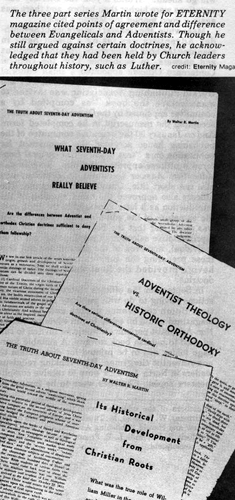 |
The
three part series Martin wrote for ETERNITY magazine
cited points of agreement and difference between Evangelicals
and Adventists. Though he still argued against certain
doctrines, he acknowledged that they had been held by
Church leaders throughout history, such as Luther. credit:
Eternity Magazine |
p
11 -- articles against Adventism. The King's
Business, official organ of the Bible Institute of Los
Angeles (BIOLA), ran articles by Louis Talbot, the editor,
attacking not only the Adventists but the editor of Eternity
as well. While these attacks could not be considered typical,
they at least showed that the editor of Time was
less than correct when he announced in the December 31,
1956 issue that the Fundamentalists had made peace with
the Adventists.
When
Eternity lost one-fourth of its subscribers in protest,
and the sale of Martin's books plummeted, Barnhouse asked
anxiously, "Are you sure of your positions?" On
Martin's affirmative answer, Barnhouse said, "Then
we will go ahead." Within a year the Eternity
subscriptions were higher than before, and there was again
a good market for Martin's books.
Meanwhile,
the General Conference of Seventhday Adventists was taking
a direct hand in planning the book taking shape from the
questions and answers. In September 1956 the General Conference
Officers appointed a small editorial committee. *
On January 23, 1957, the Review and Herald Publishing Association
was invited to manufacture the book "as compiled by
a committee appointed by the General Conference," accepting
the manuscript in its completed form. And on January 30
the executive committee of the publishing house accepted
the manuscript for publication on a "text basis."
The General Conference officers approved the title, Seventh-day
Adventists Answer Questions on Doctrine, and also the
short title, Questions on Doctrine. The officers
also approved the exact wording of the introduction as it
later appeared in the book over the signature of the editorial
committee. Here it was made clar that the book was the work
of a representative selection of participants, not of an
individual, nor even of the committee, and that those preparing
the answers made no claim to having provided the final word
on Christian doctrine.
In
September the officers recorded a series of actions having
to do with publicity and distribution. Union conference
papers and Adventist magazines would be asked to run advertisements.
Non-Adventist periodicals would be invited to run ads and
to publish book reviews. A suitable four-page folder was
to be printed for distribution to non-Adventist clergymen.
High-ranking religious leaders in North America were to
receive complimentary copies. Churches were to be invited
to put copies in their libraries and to present complimentary
copies to Protestant ministers in the community. Book and
Bible houses were to stock Questions on Doctrine.
Questions
on Doctrine was published late in 1957. It was designed
to begin with the "Statement of Fundamental Beliefs
of Seventh-day Adventists," first published in 1931,
later given General Conference approval, and regularly included
in church manuals and yearbooks of the denomination. This
was to make clear to Adventists and non-Adventists alike,
that in presenting an amplified statement on doctrine the
General Conference was not setting forth a new theology,
but was clarifying and amplifying the doctrines most generally
believed by contemporary Seventh-day Adventists. Included
in appendices was an extensive compilation from the writings
of Ellen G. White, covering such subjects as the Diety and
eternal preexistence of Christ and His place in the Trinity;
His divine-human nature in the incarnation; His completed
sacrificial atonement on the cross; and His priestly ministry
in the heavenly sanctuary. These were the areas which had
been found to be most frequently misunderstood and misquoted.
This compliation was later included in Volume 7-A of the
Seventh-day Adventists Commentary series. Many of these
same quotations appeared in the Ministry magazine,
between May 1956, and March 1957, under the title, "Counsels
from the Spirit of Prophecy."
The
editor of Ministry, R. A. Anderson, made sure during
the months preceding the publication of Questions on
Doctrine, that the Adventist clergy was fully informed
of what to expect. He described the conferences with the
Evangelicals and the removal of century-old misunderstandings.
He explained the procedure for getting a doctrinal consensus
from world leaders in the church. The unity of belief so
demonstrated he attributed to the influence of the writings
of Ellen G. White. There were also articles during this
period from W. E. Read on the nature of Christ and from
L. E. Froom on the atonement.
It
came as a surprise to the planners, after thedemonstration
of a solid consensus from world leaders in the church and
the preview in Ministry of what was to come, that
Questions on Doctrine should be subjected to attack
from Adventist sources. The critics seemed to be saying
the same things, suggesting a common source.This was not
hard to find. M.L. Andreason, a respected retired Adventist
theologian, author and Bible teacher, had widely circulated
eleven mimeographed documents and six printed leaflets addressed
to the churches. In these the writer
Webmaster
note: M. L. Andreasen, retired Seventh-day
Adventist professor at the SDA Seminary, was referred to
by his peers as "the dean of theology." Of over
250 who received copies of the manuscript for perusal, he
was not sent a copy, however, someone did provide him with
one. From his study of it, he asked for hearings to be recorded
so the church members could know about the doctrinal deviations
in the manuscript. These were refused, so he took his study
of it to the members directly through his writing of Letters
To the Churches linked here.
*
-- Members of the editorial committee: A. V. Olson (chairman),
W. E. Read, M. Thurber (book editor of the Review and Herald
Publishing Association), W. G. C. Murdoch, R. Hammill, L.
E. Froom, and R. A. Anderson, consultants.
p
12 -- accused the compilers of Questions on
Doctrine of attempting to change traditional doctrines,
and he accused the officers of the General Conference of
planning to revise the writings of Ellen White to conform.
A
formal denial of these charges was prepared by A. V. Olson,
a General Conference vice president, and chairman of the
Board of Trustees of the Ellen G. White Estate. This reply,
dated September 6, 1960, was sent at the request of the
General Conference officers to officers of the overseas
divisions of the church and to all union conference officers
and local conference presidents in the North American Division.
The incident was soon closed, and the author of the criticism
made his peace with the church to which he had formerly
given distinguished service.
The
Zondervan Publishing House had originally scheduled publication
of Walter Martin's The Truth About Seventh-day Adventism
for January 1957, as part of the series on cult apologetics.
There were delays, but so long as there was a possibility
of his book coming out first he was supplied with page proofs
of the Adventist book, so he would have reliable references.
Martin had promised that in describing the teachings of
contemporary Seventh-day Adventists he would only use statements
from the book to be published with the approval of the General
Conference. As late as October 1959, R. A. Anderson and
W. E. Read, with H. W. Lowe, chairman of the Biblical Study
and Research Group of the General Conference, were going
over Martin's gallies, preparatory to writing a statement
to be included in the book. The Truth About Seventh-day
Adventism was, and is, a notable book. In the "Foreword"
Barnhouse stated:
Since
leaders of Adventism agree that this book fairly represents
their theological position, this work is a milestone in
Christian apologetics; for, during this study, brethren
talked and prayed together, assessed each other's position
and agreed to disagree while still obeying the Lord's command
to love one another.
In
the author's "Preface" Martin reminded both Adventists
and non-Adventists that still to be healed were wounds caused
by ignorance, prejudice, and an unforgiving spirit, of which
Adventists as well as non-Adventists were guilty. But, he
wrote, the place of healing is at the cross. Meeting there,
we find strength and grace to keep the "lost commandment,
" that we love one another.
The
Adventist statement, over the name of H. W. Lowe, as it
appeared in Martin's book, asked that members of the Adventist
church, when reading the last chapter of the book, in which
Martin described his points of disagreement with Adventism,
would remember the fair and accurate statement of Adventist
teachings set forth in the earlier portions of the book.
Lowe also expressed the gratitude and respect the Adventist
leadership felt toward Martin for his correct recording
of their beliefs and for his attitude of Christian brotherhood.
In
retrospect, the publication of The Truth About Seventh-day
Adentism and Seventh-day Adventists Answer Questions
on Doctrine, improved relations between Evangelicals
and Seventh-day Adventists. Martin's book did not convince
all Adventist isolationists that its author and Barnhouse
spoke for the Evangelicals, or that fraternal relations
were desirable or safe. And the publication of Questions
on Doctrine did not
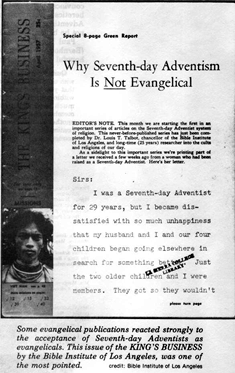 |
Some
evangelical publications reacted strongly to the acceptance
of Seventh-day Adventists as evangelicals. This issue
of the KING'S BUSINESS by the Bible Institute of Los
Angeles, was one of the most pointed. credit: Bible
Institute of Los Angeles |
p
13 -- convince all Evangelicals that Adventists
were not heretics in Christian robes. Isolated attacks on
Adventism continued. And Martin's book could not be bought
in Adventist book stores.
Paul
Hopkins, the executive secretary of the (Barnhouse) Evangelical
Foundation, struck a hopeful note in a letter to me, dated
May 6, 1960:
Quite
honestly, I can see that what you began with us is still
only the beginning and I recognize that you are going to
have the same problems within your group that we have in
ours. There is much land still to be possessed before the
members of the Body of Christ can recognize one another
as we should. In the meantime, let us continue to work and
pray that the day may come sooner than we might normally
expect.
SELECTED
SOURCES
BOOKS
Froom,
LeRoy Edwin. Movement of Destiny. Washington,
Review and Herald
Publishing Association, 1961.
Martin. Walter R. The Truth About Seventh-day
Adventists. Grand Rapids, Zon-
dervan Publishing House, 1960.
Seventh-day Adventists Answer Questions on Doctrine
Washington. Review and
Herald Publishing Association, 1957.
PERIODICALS
Eternity.
June 1950, September 1956 - January 1957.
Ministry. May, September, December. 1956,
January, March, April, 1957, March. 1958.
Sunday School Times, December 1, 1956 - January
12, 1957.
The King's Business. April - June. 1957.
Time. December 31. 1956.
INTERVIE
WS
Mrs.
Margaret Barnhouse, September 24, 1976.
Roy A. Anderson, December. 1976. January, 1977 (numerous).
LETTERS
Roy
A. Anderson, to: LeRoy E. Froom. Oct. 1956.
Donald G. Barnhouse, to: T. E. Unruh, Dec. 1949.
LeRoy E. Froom, to: R. A. Anderson. Aug. 1956: Walter
R. Martin Jan. 1956: T. E. Unruh. Aug. Nov. and
Dec. 1955. May 1960.
Paul Hopkins, to: T. E. Unruh. May 1960.
T. E. Unruh, to: Donald G. Barnhouse, Nov. 1949:
LeRoy E. Froom and W. E. Read. July 1955
|
|
|
p
14 -- Are Seventh-day Adventists
Christians?
A
NEW LOOK AT SEVENTH-DAY ADVENTISM - by Donald Grey
Barnhouse - In the past two years several evangelical
leaders have come to a new attitude toward the Seventh-day
Adventist church. The change is a remarkable one since it
consists in moving the Seventh-day Adventists, in our opinion,
out of the list of anti-Christian and non-Christian cults
into the group of those who are brethren in Christ; although
they still must be classified, in our opinion, as holding
two or three very unorthodox and in one case peculiar doctrines.
The steps in our change of attitude must be traced and the
justification of our changed attitude documented. Adventists
who read this should realize that evangelical readers have
been conditioned through the years for thinking that Adventists
must be classified as non-Christians. This present article
will explain reasons why this should no longer be so.
Our
change of attitude goes back to our acquaintance with a
young man whom I first knew in New York City as a member
of my weekly Bible class there. When I first knew him, the
Rev. Mr. Walter R. Martin was still in his early twenties,
busily engaged in his study of American religious history.
He is at present a candidate for the degree of Doctor of
Philosophy in New York University, working on his thesis
in the field of non-Christian religions that had their beginning
in America. Of these the best known are Christian Science,
Jehovah's Witnesses, Mormonism, Unity, and up until very
recently Seventh-day Adventism.
Already
Mr. Martin's volumes Jehovah of the Watchtower, The Christian
Science Myth, The Rise of the Cults, and a textbook, The
Christian and the Cults, have become standard works in their
field. * Mr. Martin joined the staff of ETERNITY
magazine first as consulting editor on the cults and now
as a full-time member of the staff of the Evangelical Foundation.
A
little less than two years ago it was decided that Mr. Martin
should undertake research in connection with Seventh-day
Adventism. We got into touch with the Adventists saying
that we wished to treat them fairly and would appreciate
the opportunity of interviewing some of their leaders. The
response was immediate and enthusiastic.
Mr.
Martin went to Takoma Park, Washington, D. C., the headquarters
of the Seventh-day Adventist movement. At first the two
groups looked upon each other with great suspicion. Mr.
Martin had read a vast quantity of Adventist literature
and presented them with a series of approximately forty
questions concerning their theological position. On a second
visit he was presented with scores of pages of detailed
theological answers to his questions. Immediately it was
perceived that the Adventists were strenuously denying certain
doctrinal positions which had been previously attributed
to them. As Mr. Martin read their answers he came, for example,
upon a statement that they repudiated absolutely the thought
that seventh-day Sabbath keeping was a basis for salvation
and a denial of any teaching that the keeping of the first
day of the week is as yet considered to be the receiving
of the anti-Christian "mark of the beast." He
pointed out to them that in their book store adjoining the
building in which these meetings were taking place a certain
volume published by them and written by one of their ministers
categorically stated the contrary to what they were now
asserting. The leaders sent for the book, discovered that
Mr. Martin was correct, and immediately brought this fact
to the attention of the General Conference Officers, that
this situation might be remedied and such publications be
corrected. This same procedure was repeated regarding the
nature of Christ while in the flesh which the majority of
the denomination has always held to be sinless, holy, and
perfect despite the fact that certain of their writers have
occasionally gotten into print with contrary views completely
repugnant to the Church at large. They further explained
to Mr. Martin that they had among their number certain members
of their "lunatic fringe" even as there are similar
wild-eyed irresponsibles in every field of fundamental Christianity.
This action of the Seventh-day Adventists was indicative
of similar steps that were taken subsequently.
The next phase of the discussion moved in August, 1955,
to a place in the country outside Philadelphia. There, four
of the leaders of Seventh-day Adventist thought came for
a two-day conference in the home of the editor-in-chief
of ETERNITY. Here they, together with Mr. Martin and Professor
George Cannon of the Nyack Missionary College, spent two
full days going over the approximately hundred pages of
the Seventh-day Adventist answers to Mr. Martin's questions.
At the outset the seven of us, on our knees, prayed together
approaching God through the Lord Jesus Christ alone.
At
that time I made a statement to these men approximately
*
-- These are all available from ETERNITY Book Service.
The
true life of prayer is a life completely given to God
p
15 -- as follows: I want to explain to you my
attitude toward Seventh-day Adventism. In the providence
of God I was born in a little town in California about forty
miles away from Mountain View where Ellen G. White, revered
teacher in the Adventist movement, had her headquarters.
At that time the followers of the Adventist movement that
came into our town and others of the region were, from our
point of view, colossally ignorant fanatics. We considered
them to be the descendants of the Millerites who in 1844
were supposed to have gone on top of a hill to await the
Second Coming of Christ on a certain night, and who were
utterly deceived and discredited. We understood that the
Seventh-day Adventists believed the devil to be the sinbearer,
* that a person had to keep Saturday in order to be
saved, * thus denying the finished work of the
Lord Jesus Christ. Later on all of my bad opinions about
the Adventist movement had been confirmed and established,
I thought, by books which had been written by men who had
been Adventist preachers and who had left the movement;
notably, there was a series of works by E. B. Jones which
showedd that he had been a Seventh-day Adventist layman
missionary and had believed a long list of horrible things
which he had since abandoned now that he had been "saved."
I
went on to state to my guests that in many conversations
with Walter Martin through the previous year and through
reading their prepared statements I had come to see that,
beyond question, there were sober, sane, truly regenerated
men among the leaders of the Seventh-day Adventist church.
While they still held positions which were totally alien
to my thinking and which I had to repudiate, I was ready
to admit that some of these positions had been held in the
past by noted Christians (Martin Luther held one of these
positions which with the modern Lutheran church I repudiate),
and that I was ready to extend a hand to these men as Christian
brethren though I still reserve the right strenuously to
refute the two or three positions which evangelicals hold
to be in error.
These
leaders accepted my explanation and acknowledged that they
understood the difficulties.
The
seven of us worked through the Adventist statement for two
days. Mr. Martin had further conferences with the Adventist
leaders in Washington, D. C., and in Glendale, California.
He was invited to preach in two of the large Adventist churches
in the country and spoke to their theological seminary and
to the employees of the Voice of Prophecy broadcast. In
May, 1956, the same group of Adventist leaders returned
to my home in Pennsylvania for another two-day conference.
Now
the time has come to make known to the general public the
results of the hundreds of hours of labor that have been
expended by Mr. Martin and the similar time that has been
put forth by many Adventist leaders.
Mr.
Martin's book on Seventh-day Adventism will appear in print
within a few months. It will carry a foreword by responsible
leaders of the Seventh-day Adventist church to the effect
that they have not been misquoted in the volume and that
the areas of agreement and disagreement as set forth by
Mr. Martin are accurate from their point of view as well
as from our evangelical point of view. All of Mr. Martin's
references to a new Adventist volume on their doctrines
will be from the page proof of their book, which will appear
iri print simultaneously with his work. Henceforth any fair
criticism of the Adventist movement must refer to these
simultaneous publications.
The
position of the Adventists seems to some of us in certain
cases to be a new position; to them it may be merely the
position of the majority group of sane leadership which
is determined to put the brakes on any members who seek
to hold views divergent from that of the responsible leadership
of the denomination.
(1)
Notably, the Adventist leadership proclaims
that the writings of Ellen G. White, the great counselor
of the Adventist movement, are not on a parity with Scripture.
While the Adventist church claims to have received great
blessing from the ministry of Mrs. White, they admit her
writings are not infallible, but in all fairness they do
revere her writings as special counsels from God to their
movement. Her writings incidentally are not a test of fellowship
in the Seventh-day Adventist church.
(2)
While the Adventists keep Saturday as the Sabbath, they
specifically repudiate the idea that Sabbath-keeping is
in any way a means of salvation. They acknowledge freely
that Christians today who keep Sunday in good faith are
as much members of the Body of Christ as they are.
(3)
To avoid charges that have been brought against
them by evangelicals, Adventists have already worked out
arrangements that the Voice of Prophecy radio program and
the Signs of the Times, their largest paper, be identified
as presentations of the Seventh-day Adventist church.
The
Adventists specifically repudiate any teachings by ministers
or members of their faith who have believed,
(Continued
on page 43)
|
Have
the Seventh-day Adventists been proselytizers?
During the course of our dealings with Adventist leaders
we brought up the complaints, common on the mission
field, that Adventist missionaries and workers have
been proselytizers. The leaders affirmed vehemently
that they have been doing everything possible to prevent
such proselytizing, and, while there may have-been
such cases in the past, they hold that such methods
are not now in use. In cooperation with them we will
gladly receive from any missionaries in the world
fully-documented instances of such proselytization
that have taken place during the past two years. Such
documentation, if any, sent to the Rev. Mr. Walter
R. Martin, in care of ETERNITY, will be forwarded
to Adventist leaders, who have promised a thorough
investigation.
|
*
-- Absolutely repudiated in Seventh-day Adventist theology
today we are now informed.
p
16 --
SEVENTH-DAY
ADVENTISTS
proclaimed, and written any matter which would classify
them among Arians. That is to say, they hold that Jesus
Christ is the eternal Word of God, second member of the
Godhead, eternally existing with God as God, and they repudiate
absolutely any concept that Jesus was a created being. While
many of their Bible teachers have shown that "the angel
of Jehovah" in the Old Testament is none other than
Jesus Christ, this position is one that I myself have taken
and taught in my book, The Invisible War. The word "angel"
means "messenger" and Christ's action as a "messenger"
did not and does not make Him a creature or less than God.
This declaration on the part of the Adventist leaders specifically
removes them from classification with Jehovah's Witnesses
who are Arians in the modern sense, and the Adventists totally
repudiate the Jehovah's Witnesses' concept of Christ. The
Adventists take their place in the very center of traditional
Christianity's Trinitarian doctrine as accepting the Christology
of the New Testament of the Fathers, the Reformers, and
all true evangelicals.
(4)
The Seventh-day Adventist position on salvation is Arminian,
classifying them with Wesley and the modern groups such
as the Holiness and Nazarene movements. I discovered, however,
in our long talks together that these brethren have what
I think is a misconception of Calvinism. They would not
find it too hard to get along with the modern Calvinism
which is held by most evangelical Baptists and Presbyterians
today and vice versa.
We
discovered that there are still some sharp areas of disagreement.
To my mind, the most important of these is the Adventist
belief in "conditional immortality." They believe
that death brings unconscious "soul-sleeping"
and that the lost are to be annihilated, thus denying the
doctrines of hell and eternal punishment. When we realize,
however, that both Martin Luther and William Tyndale held
this doctrine, we cannot on this ground alone divorce the
Adventists or sever them from the true Body of Christ. We
most heartily disagree with them on these doctrines and
pray that they will soon move to a position of belief with
the vast majority of evangelical Christians throughout the
centuries.
We
also disagree on the question of the Seventh-day Sabbath.
A great amount of time was spent in our early meetings to
spell out the fact that Adventists do not believe in legalism
as a part of salvation though everything in their practice
seems to indicate that they do. They recognize clearly that
some of their teachers have taught the contrary, but they
take a position (to us very illogical) that the Ten Commandments
are to be obeyed, but that their teaching has no part whatsoever
as a down payment or a part payment toward salvation which
they and we in common confess to be by Christ alone on the
basis of His expiatory death on Calvary.
The
final major area of disagreemen is over the doctrine of
the "investigative judgment," which is a doctrine
never known in theological history until the second half
of the nineteenth century and which is a doctrine held exclusively
by the Seventh-day Adventists. At the very beginning of
our contacts with the Adventist leaders, Mr. Martin and
I thought that this would be the doctrine on which it would
be impossible to come to any understanding which would permit
our including them among those who could be counted as Christians
believing in the finished work of Christ. In order to understand
this doctrine of "investigative judgment" it is
necessary to devote a few paragraphs to Adventist history.
In
the early nineteenth century there was a great increase
in the study of Bible prophecy. Dr. LeRoy Froom, the eminent
Adventist historian, in his monumental four-volume history
of the development of Adventist teaching on prophecy, shows
clearly that innumerable Bible students from a score of
denominational affiliations were carried away with date-setting
for the Second Coming of Christ. The reason for this is
(what I believe to be) a false interpretation of Daniel's
prophecy of 2,300 days. In Daniel 8:14 a figure is given
of 2,300 days. In the early nineteenth century it became
fashionable to equate this with 2,300 years, interpreting
this verse by association with Ezekiel 4:6 where it is stated,
"I have appointed thee each day for a year." Since
2,300 years from Daniel would fall toward the end of the
first half of the nineteenth century, thousands of people
believed that the Second Coming of Christ would take place
in that period. Anglicans, Presbyterians, Lutherans, etc.
spent extraordinary amounts of time and effort in figuring
out the chronologies, and ultimately the consensus agreed
on 1844.
It
should be realized that there was no Seventh-day Adventist
church at that time. All of these. "Adventists"
were in the major denominations. One William Miller of Baptist
background even placed the advent between specific months.
The newspapers of America were filled with headlines concerning
the matter. A historical study of the events demonstrates
that these people were serious-minded students who were
definitely self-deceived. The story that they dressed in
flowing white robes and went to the top of a hill has been
exploded. Hoodlums did dress up in flowing robes and in
ribald fashion mocked these people, but they themselves
were dreadfully sincere.
Dr.
Froom, in the fourth volume of his work, describes these
events as "The Great Disappointment." Out of the
"Great Disappointment" grew the Seventh-day Adventist
church. It will be impossible to understand the movement
unless it is realized that most of the Adventists before
1844 kept Sunday, were found in dozens of denominations,
and had no common doctrine or organization. In their disappointment
little segments of these disillusioned people drew together.
One of the segments kept Saturday as the Sabbath. Still
another of the segments believed in conditional immortality
and soul-sleeping, and a third segment fell upon the doctrine
of "the investigative judgment." The latter doctrine,
to me, is the most colossal, psychological, face-saving
phenomenon in religious history! It would further seem to
me that the various segments, each with a distinctive doctrine
not held by the majority of Christendom, drew together and
consolidated on the basis of the acceptance of each other's
peculiar heterodox teachings. The error of conditional immortality
and the error of Sabbatarianism are both well known. That
of the "investigative judgment," however, now
requires further explanation.
On
the morning after the "Great Disappointment,"
two men were going through a corn field in order to avoid
the pitiless gaze of their mocking neighbors to whom they
had given their final witness and had said an eternal goodbye
the day before. To put it in the words of Hiram Edson (the
man in the corn field who first conceived this peculiar
idea), he was overwhelmed with the conviction "that
instead of our High Priest coming out of the Most Holy of
the heavenly sanctuary to come to this earth on the tenth
day of the seventh month at the end of 2,300 days.
p
17 -- He for the first time entered on that day
the second apartment of that sanctuary, and that He had
work to perform in the Most Holy before coming to this earth."
It is to my mind, therefore, nothing more than a human,
face-saving ideal It should also be realized that some uninformed
Seventh-day Adventists took this idea and carried it to
fantastic literalistic extremes. Mr. Martin and I heard
the Adventist leaders say, flatly, that they repudiate all
such extremes. This they have said in no uncertain terms.
Further, they do not believe, as some of their earlier teachers
taught, that Jesus' atoning work was not completed on Calvary
but instead that He was still carrying on a second ministering
work since 1844. This idea is also totally repudiated. They
believe that since His ascension Christ has been ministering
the benefits of the atonement which He completed on Calvary.
Since the sanctuary doctrine is based on the type of the
Jewish high priest going into the Holy of Holies to complete
his atoning work, it can be seen that what remains is most
certainly exegetically untenable and theological speculation
of a highly imaginative order. What Christ is now doing,
since 1844, according to this version, is going over the
records of all human beings and deciding what rewards are
going to be given to individual Christians. We personally
do not believe that there is even a suspicion of a verse
in Scripture to sustain such a peculiar position, and we
further believe that any effort to establish it is stale,
ftat, and unprofitable! This doctrine is linked with that
of the scapegoat (Azazel) of Leviticus 16, whom Seventh-day
Adventists, in company with not a few recognized non-Adventist
Hebrew scholars, believe to be Satan. It should be noted,
however that the transaction with the scapegoat is in no
way to be construed as part or completion of the atonement
which Adventists believe Christ alone vicariously made on
Golgotha. The meaning of the "scapegoat" teaching
is that Satan merely bears away into final annihilation
his responsibility in tempting man to sin, much as the master
criminal who must pay a penalty for plotting and directing
a crime though he never actually committed it. This concept
while admittedly strange is not heretical because it is
divorced from the doctrine of the atonement in Adventist
theology so that it becomes only a kind of "legal transaction"
not in any sense a vicarious bearing of sharing in the sin
atonement of Christ on the Cross. This editor, of course,
flatly rejects such an interpretation and reserves the right
to consider it as a somewhat bizarre excursion into the
field of speculative theology.
To
sum up, I would say that the differences between other evangelicals
and the Seventh-day Adventist position are three:
(1)
The unimportant and almost naive doctrine of
the "investigative judgment."
(2) The more serious doctrine of Sabbath-keeping,
which is not sufficient to bar Seventh-day Adventists from
the fellowship of true Christians but which makes such fellowship
very difficult because of the overtones of legalism that
has a tendency to gnaw at the roots of the truth of sovereign
grace to unworthy sinners; and
(3) Finally, the most serious difference,
to me, is their belief in conditional immortality (i.e.,
soul-sleeping and the anniliilation of the lost). The tact
that they can name the names of famous Christian theologians
or thinkers who have believed this error is no justification
for our believing it, since it so thoroughly contradicts
the historic biblical position. "To depart" is
not to be unconscious in sleep, but to be with Christ "which
is far better." (Phil. 1:21-23). I will save the detailed
refutation of this doctrine for a further issue.
In
conclusion, I should like to say that we are delighted to
do justice to a much-maligned group of sincere believers,
and in our minds and hearts take them out of the group of
utter heretics like the Jehovah's Witnesses, Mormons, and
Christian Scientists, to acknowledge them as redeemed brethren
and members of the Body of Christ. It is our sincere prayer
that they may be led to consider further the points on which
they are so widely divergent from the rest of the Body of
Christ and in so doing promote their own spiritual growth
and that of their fellow Christians. END
p
18 -- The
Truth About Seventh-day Adventism -
by Walter R. Martin -- Its
Historical Development from Christian Roots -- What
was the true role of William Miller in the great advent
awakening movement? -- Seventh-day
Adventism, as a religious movement, sprang from the great
second advent "awakening" which shook the religious
world toward the middle of the nineteenth century.
During
this particular period of theological development, speculation
relative to the second advent of Jesus Christ had been rampant
on the continent of Europe, and it was not long before the
European prophetic scheme of interpretation bridged the
Atlantic and penetrated American theological circles.
Based
largely upon the books of Daniel and Revelation (both apocalyptic),
advent theology became a topic of conversation discussed
in newspapers as well as theological journals; in short,
New Testament eschatological study suddenly competed with
current stock market quotations for front-page space, and
the "seventy weeks," "twenty-three hundred
days," and "the abomination of desolation"
(Dan. 8, 9) became common subjects of conversation.
Following
the chronology of Archbishop Ussher and interpreting the
twenty-three hundred days of Daniel as literal years, many
Bible students of various faiths concluded that Christ would
come back near or about the year 1843. Of this studious
number was one William Miller, a Baptist minister and resident
of Low Hampton, New York, who arrived at the final date,
October 22, 1844, as the time when Jesus Christ would return
for His saints and usher in judgment upon sin, culminating
in the establishment of the Kingdom of God upon earth.
The
great second advent movement, which was to sweep the United
States particularly in the early 1840's, stemmed from the
activities of this William Miller, who confidently taught,
beginning in the year 1818, that in "about" twenty-five
years from that date, i.e. 1843, Jesus Christ would come
again, or as Miller himself put it, "I was thus brought
in 1818 at the close of my two-year study of the Scriptures
to the solemn conclusion that in about twenty-five years
from that time all the affairs of our present state would
be wound up" (The Midnight Cry, Francis D. Nicol,
p. 35, Review and Herald, Washington, D. C.).
Lest
anyone reading the various accounts of the rise of Millerism
in the United States come to the unwarranted conclusion
that Miller was a "crackpot" and an uneducated
tool of Satan, the following facts should be known: The
great advent awakening movement which spanned the Atlantic
from Europe was bolstered by a tremendous wave of contemporary
biblical scholarship, and, though Miller himself was uneducated,
there were literally scores and scores of interpretative
prophetic scholars, both in Europe and the United States,
who espoused Miller's view before he himself announced it;
and in reality his was only one more voice proclaiming the
1843/1844 fulfillment of Daniel 8:14, or the twenty-three-hundred
days' period allegedly dating from 457 B.C. and ending in
1843/1844. William Miller was born in Pittsfield, Massachusetts,
on February 15, 1782, and while still a young child his
family
relocated in Low Hampton, New York, close to the Vermont
State borderline. Miller was raised by a deeply religious
mother, but despite her zeal for his conversion Miller himself
at length became an infidel, and only after a soul-searching
experience which culminated in his conversion did he begin
his preparation for the ministry in the Baptist Church.
A great many books have been written about William Miller
and the rise of the Millerite movement, but to this writer's
knowledge none of them has ever accused Miller on verifiable
grounds of being either dishonest or deceptive in his prophetic
interpretation of Scripture. Indeed, he always enjoyed the
reputation among all who knew him as an honest, forthright,
Christian man. One does not have to endorse the errors of
Millerism and its unbiblical date-setting record, therefore,
to have respcct for the historical figure of William Miller,
for regardless of his shortcomings Miller himself was a
deeply religious Christian who, had he had the benefit of
a more extensive understanding of the Scriptures, most probably
would never have embarked upon his date-setting career.
Clearly
it may be seen that although Miller popularized the 1843/44
concept of Christ coming again, he was far from being alone;
it we hold Miller up for scorn we must also hold up a whole
ream of internationally known scholars who have some of
the best educations in the world but who had a "blind
spot" in prophetic interpretation and so endorsed the
Millerite interpretational system of
--
This is the first of three articles. Next month Adventist
theology will be examined.
p
19
--

chronology.
It was the Lord Jesus Christ who said, "No one knoweth
the hour of my return," and at another time the Master
plainly stated that it was not given to us, His followers,
to know the times nor the seasons "which the Father
hath put in his own power." This should have been enough
to deter the Millerites from their foolhardy quest to set
a date for the return of the Lord, but, unfortunately, they
persisted in their chronological speculations and suffered
tremendous humiliation, ridicule, and abject despair.
According
to the prophetic interpretations of William Miller, he had
set the time for the probable return of the Lord somewhere
between March 21, 1843 and March 21, 1844 (The Midnight
Cry, p. 169), and as the time drew nigh a religious
frenzy shook the Millerite world - the Lord was coming back!
Zealous
though the followers of Miller were and terribly sincere
in their faith as they must have been, stark disappointment
waited them as the Jewish year "1843" faded from
time and the Lord had not come. As the realization that
the dream closest to their hearts had not materialized sank
into the consciousness of the disillusioned Millerites,
word from William Miller was eagerly sought, and with his
characteristic honesty it was shortly forthcoming. Wrote
Miller in the very shadow of spiritual anguish: "Were
I to live my life over again, with the same evidence that
I then had, to be honest with God and man I should have
to do as I have done. Although opposers said it would not
come, they produced no weighty arguments. It was evidently
guess-work with them; and I then thought, and do now, that
their denial was based more on an unwillingness for the
Lord to come than on any arguments leading to such conclusion.
I confess my error, and acknowledge my disappointment; yet
I still believe that the Day of the Lord is near, even at
the door; and I exhort you, my brethren, to be watchful
and not let that day come upon you unawares" (Memoirs
of William Miller, Sylvester Bliss, p. 256).
In
the wake of this stunning declaration by their leader, the
Millerites strove vainly to reconcile the prophetic interpretation
of the Scripture to which they had adhered with the stark
reality of the fact that Christ had not come again. And
with one last gasp, so to speak, Miller with reluctance
endorsed what has come to be known historically as "The
Seventh-month Movement" or the belief that Christ would
come on October 22, 1844, the tenth day of the seventh month
according to the Karaite reckoning of the Jewish Sacred
Calendar (The Midnight Cry, p. 243). Once again the
Millerites' hopes were lifted, and October 22, 1844 became
the new battle cry for the return of the Lord Jesus Christ.
The outcome of the "Seventh-month Movement" can
best be summed up in the words of Dr. Josiah Litch, one
of the leaders of the Millerite movement, who from his home
in Philadelphia wrote on October 24 these words, "It
is a cloudy and dark day here - the sheep are scattered
- the Lord has not come yet" (The Midnight Cry,
p. 263).
From
Litch's statement, it is a simple matter to piece together
the psychological framework of the Millerites in the wake
of these two disappointments. They were shattered and disillusioned
people - Christ had not come to cleanse the sanctuary, to
usher in judgment, and to bring the world into subjugation
to the "everlasting gospel." Instead, the physical
sky was cloudy and dark, and the historical horizons were
black with the failure of the Millerite movement. There
was, understandably, terrible confusion, of which God, the
Scripture tells us, is not the author.
The
final phase of the Millerite movement, then, came to a close
with the "Great Disappointment" of 1844, and as
the Millerites began to disintegrate as a movement there
gradually emerged other groups (First-day Adventists, etc.)
but in our study we are concerned primarily with three distinct
segments which later joined in an indissoluble fusion eventually
producing the Seventh-day Adventist denomination as we know
it today. William Miller, it should be noted, was never
a Seventh-day Adventist and confessed himself that he had
"no confidence" in the "new theories"
which emerged from the shambles of what was previously the
Millerite movement. Dr. LeRoy Froom of the Seventh-day Adventist
Theological Seminary, in the fourth volume of his masterful
series The Prophetic Faith of our Fathers, p. 828-29,
succinctly states exactly what Miller's position was. Wrote
Dr. Froom: "Miller was out-spokenly opposed to the
various new theories that
had developed following October 22, 1844, in an endeavor
to explain the disappointment. He deplored the call to come
out of the churches that had been given, and he never accepted
the distinctive positions of the Sabbatarians. The doctrine
of the unconscious sleep of the dead and the final destruction
of the wicked was not, he maintained, part of the original
Millerite position, but was introduced personally by Storrs
and Litch. He even came to deny the application of a parable
in The
Midnight Cry
to the Seventh-month Movement and eventually went so far
as to declare unequivocably that the movement was not 'a
fulfillment of prophecy in any sense.' "
The
theology of William Miller, then, except for his chronological
speculation, differed from the Seventh-day Adventist theological
interpretations in these three distinct ways: Miller denied
the Seventh-day Sabbath, the doctrine of the unconscious
sleep of the dead, and the final annihilation of the wicked
- all doctrines held by the Seventhday Adventist denomination.
He also differed theologically
p
20 --
in that he never held to the "day of atonement"
and "investigative judgment" theories as developed
by Seventh-day Adventists. For William Miller the era of
chronological speculation was over, and he died shortly
thereafter, a broken and disillusioned man who was, nevertheless,
honest and forthright when in error or when repudiating
error, and there can be no honest doubt that he now enjoys
the presence of the Lord whose appearing he so anxiously
awaited.
We
return now to the three branches or groups which eventually
united to form the Seventh-day Adventist denomination, for
it is important that the reader understand the early background
of Seventh-day Adventist history and theology.
Each
of the three groups mentioned held a distinctive doctrine.
The group headed by Hiram Edson in western New York proclaimed
the doctrine of the sanctuary "as embracing a special
or final ministry of Christ in the Holy of Holies in the
heavenly sanctuary, thus giving new meaning to the message,
'The Hour of God's Judgment has come.'" The second
group, headed by Joseph Bates, with the main following in
Massachusetts and New Hampshire, advocated the Sabbath feature
or observance of the Seventh-day "as involved in the
keeping of the commandments of God." The third group
emphasized the "spirit of prophecy" or the testimony
of Jesus, which they believed was to be manifest in the
"remnant church" (Rev. 15:6-12, also Rev. 12:17,
19:10), or " The last segment of God's church of the
centuries." Between theyears 1844 and 1847 the thinking
of these two groups chrystalized and was actively declared
and promulgated in the writings of their respective leaders,
Hiram Edson, O. R. L. Crosier, Joseph Bates, James While,
and Ellen White.
Though
the name "Seventh-day Adventist denomination"
was not officially assumed by the group until 1860 at a
conference held in Battle Creek, Michiganl, Seventh-day
Adventism had been born, and in 1855 the headquarters of
the movement was centralized in Battle Creek, where it remained
until 1903, when the national headquarters was moved to
Washington, D. C.
The
three distinctive doctines of Seventh-day Adventism, which
were previously enumerated, will he discussed along with
others in the second and third articles of this series on
Seventh-day Adventism, so at this time we shall omit any
discussion of them. However, the Adventists had a definite
theological platform, which through the years has varied
little, but which in comparatively recent years has undergone
a very definite evolution toward a more forthright declaration
concerning the principles of the historic Christian faith,
especially as they are embodied in the tenets of orthodox
Christian theology. These matters as previously stated will
be discussed in our second and third articles.
As
is the case with most religious movements, one extraordinary
personality often dominates the entire history of the group,
and Seventh-day Adventism is no exception to this rule.
The dominant personality of Seventh-day Adventism was Ellen
G. White, one of the most fascinating figures ever to appear
upon the horizon of religious history, and a controversial
personage whose memory and work have been alternately praised
by Adventists and damned by their enemies since the early
years of the movement's history. Born Ellen Gould Harmon
in Gorham, Maine in 1827, and reared a devout church-going
Methodist in the city of Portland, Mrs. White, early in
her religious experience, became known as an unusual person,
for she bore witness to certain "revelations,"
which she believed she had received from Heaven, and as
eary as the age of seventeen embraced the Adventist faith
of the Millerites (E. G. While, Life.Sketches, pp. 64-68).
Although
Mrs. While, after her marriage James White, a prominent
Adventist leader, eventually exerted a tremendous influence
upon the thinking al Seventh-day Adventists - and does to
this day through her prolific writings - she never claimed
for herself infallibility in matters of inspiration; or
as Dr. Froom has put it, "She neither claimed nor accepted
the role of infallibility, which is vastly different from
inspiration, or the influence of the spirit of God upon
the spirit of the submissive servant and messenger. Like
the prophets of old she illuminated and applied truth and
gave guidance to her fellow believers. She did not lay claim
to the title of prophet, preferring to he called a 'messenger'
and `servant' of God."
The
writer has read extensively in the publications of the Seventh-day
Adventist denomination and almost all of the writings of
Ellen G. White, including her testimonies, and feels free
to state that there can be no doubt that Mrs. White was
a "born again" Christian woman who truly loved
the Lord Jesus Christ and who dedicated herself unstintingly
to the task of bearing witness for Him as she felt led.
It should be clearly understood that in some places orthodox
Christian theology and the interpretations of Mrs. White
do not agree; in fact, in some places they are at direct
loggerheads, but on the cardinal doctrines of the Christian
faith necessary to the salvation of the soul and the growth
of the life in Christ, Ellen G. White has never written
anything which is seriously contrary to the simple, plain
declarations of the gospel. One may disagree with Mrs. White's
interpretation of the atonentent and the scapegoat; one
may challenge her stress upon the Seventh-day Sabbath, health
reform, and conditional
immortality, etc.; but no one can fairly challenge her writings
on the basis of their conformity to the basic principles
of the gospel, for conform they most certainly do! Many
critics of Seventh-day Adventism have assumed a priori-mostly
from the writings of professional Adventist detractors such
as E. B. Jones - that Mrs. White was a fearsom ogre who
devoured all who opposed her, and they have never stopped
saying that Seventh-day Adventists believe that she is infallible
despite the published official position of the denomination,
which states the direct contrary to these perversions. To
quote the official denominational position: "Ellen
G. White's writings are not the source of our expositions.
We derive our faith from the Scriptures, and our interpretations
of prophecy were all established before Mrs. White spoke
or wrote thereon. We hold her Writings in highest esteem
and beleive that the holy Spirit illuminmed her mind in
the penning of these counsels to the Seventh-day Adventist
Church. Their conformity with biblical, historical, and
scientific facts is truly remarkable we feel, but we do
not and never have put them on a parity with Scripture as
some falsely charge."
In
addition to this statement the following comment from representatives
of the General Conference of Seventh-day Adventists, which
is the governing hody and voice of Seventh-day Adventism
worldwide, clearly states the denominational position relative
to Ellen G.White: "Seventh-day Adventists uniformly
believe that the canon of Scripture closed with the book
of Revelation. We hold that all writings and teachings are
to be judged by and are subject to the Bible, which stands
alone and unique as the source and norm of our Christian
faith. We do not consider Ellen G. White to be in the category
of the writers of the canon of Scripture. Her writings are
regarded by Adventists as containing special counsel from
God concerning personal religion and the conduct of our
denominational work. That portion of her writings which
might be classified as prediction actually forms a very
small segment. And even when she deals with what is coming
on earth, her statements are only amplifications of Bible
prophecy. She did not assume the title of
p
21 --prophet,
but simply a messenger of the Lord. "To claim to be
a prophetess is something that I have never done... but
my work has covered so many lines that I cannot call myself
other than a messenger sent to bear a message from the Lord'
" (Review and Herald, July 26, 1906).
While
it is true that Seventh-day Adventists hold Mrs. White and
her writings in great esteem, the Bible is their only rule
of faith and practice. We as fellow Christians may violently
disagree
with their attitude toward Mrs. White, but nothing she ever
wrote on those doctrines essential to salvation or Christian
living would characterize her in any way as being other
than a Christian in every sense of the term.
D.
M. Canright, 1 in his two
books on Ellen G. White, has gone into great critiral details
based upon his early association and personal acquaintance
with Mrs. White, and many of the points which Canright makes
from the standpoint of a personal opinion no one is capable
of challenging for the simple reason that nobody ever had
source material enough to question Brother Canright's analysis.
Having read D. M. Canright, E. B. Jones, and every major
work on Seventh-day Adventism printed in the United States
and Europe over the past fifty-seven years, the writer,
too, is unable to determine whether or not Canright's judgments
where Mrs. White is concerned are 100 per cent valid. If
the reader is seriously interested in a comparison of the
two positions he is urged to read F. D. Nicol's book, Ellen
G. White and Her Critics and compare it with Canright's
volumes, The Life of Mrs. E. G. White and Seventh-day
Adventism Renounced, at the end of which reading he
is free to make up his own mind as to the character and
work of Ellen G. White. To this writer as a student of comparative
religions it is irrelevant whether or not Mrs. White as
a person was actually everything that Brothers Canright
or Nicol proclaim. After all, she never claimed infallibility
for herself, and, therefore, to refute Ellen G. White either
as a person or theologically is certainly not to refute
Seventh-day Adventism per se, for there are schools of interpretation
within the Seventh-day Adventist movement which disagree
with Ellen G. White's interpretations on some points, and
it is significant to note that her writings are not a test
of fellowship in the denomination! To emphasize this point
the Review and Herald, February 15, 1870, made the
following statement: "We therefore do not test the
world in any manner by these gifts. Nor do we in our intercourse
with other religious bodies who are striving to walk in
the fear of God in any way make these a test of Christian
character."
Another
significant fact is that James White, three times President
of the General Conference of Seventh-day Adventists, when
speaking on the work of his wife, expressly declared that
"Adventists do not, however, make a belief in this
work a test of Christian fellowship" (Review and
Herald, June 13, 1871). F. M. Wilcox who for thirty-five
years was editor of the Review and Herald, the Adventist
denominational church paper, wrote, "In the practice
of the church it has not been customary to disfellowship
one because he did not recognize the doctrine of spiritual
gifts... A member of the church should not be excluded from
the membership of the church because of his inability to
recognize clearly the doctrine of spiritual gifts and its
application to the second advent movement" (The
Testimony of Jesus, pp. 141, 143).
Today
the Seventh-day Adventist denomination numbers over a million
throughout the world, operates a total of forty-two publishing
houses and produces literature in more than two hundred
languages, while publishing over three hundred periodicals,
which include correspondence courses, Sabbath School lessons,
etc. In their Bible study courses, advertised over the Voice
of Prophecy, their official denominational radio program,
the Adventists have enrolled more than three million persons,
and the Signs of the Times, their weekly paper, has
a circulation of over a million copies per month.
In
addition to their tremendous printed propaganda the Adventists
have excelled in medical works on the mission field and
in the United States and have numerous sanitariums and hospitals,
which enjoy excellent reputations.
We
cannot hope to cover the entire scope of Seventh-day Adventist
historical development in an article of this length. However,
enough has been shown to indicate clearly that from meager
beginnings in the wake of the Great Disappointment of 1844
and the collapse of the Millerite movement, the Seventh-day
Adventist denomination has pressed forward and expanded
until today it constitutes an important segment of American
Protestantism. Its theology will be the subject of our next
article.
1
-- An
ex-Adventist leader of great magnitude and a personal friend
for many years of Ellen G. White. He left the movement,
became a Baptist minister, and wrote much against SDA. His
criticisms where they bear upon the Sabbath, soul sleep,
annihilation of the wicked, the sanctuary doctrine, the
investigative judgment, the spirit of prophecy as manifested
in Mrs. White, and health reform in SDA are frequently well
taken; however, much has changed since Canright's day and
his work must be viewed in the light of current SDA theology.
p
22 -- The
Truth About Seventh-day Adventism -
by Walter R. Martin -- What
Seventh-day Adventists Really Believe -- Are
the differences between Adventist and orthodox Christian
doctrines sufficient to deny them fellowship? -- We
saw in our first article of the series something of the
origin, growth and development of Seventh-day Adventism
as a movement. Now we shall review briefly Adventist theology
of today. The theology of Seventh-day Adventism can be divided
into three separate sections, as follows:
(1)
Cardinal Doctrines of the Christian Faith: The doctrine
of the Trinity, the virgin birth of Christ, the perfect
human nature of Christ during the incarnation, His eternal
deity, the vicarious atonement of Christ on the cross for
all sin, the bodily resurrection of our Lord from the grave,
and His visible second advent to judge the world. On these
basic fundamentals of the gospel of Jesus Christ, Seventh-day
Adventists are solidly in the tradition of historic orthodox
Christianity. And without hesitation they recognize the
Bible alone as the inspired, inerrant Word of God,
the only rule of faith and practice.
(2)
Alternate Views on Secondary Teachings: The second,
section of theological beliefs concerns alternate views
on biblical doctrines, either view being admissible from
the standpoint of Christian belief and argument, such as
Arminianism versus Calvinism, Historicist eschatology versus
Futurist, etc., so that the Adventists find themselves at
times on one side and at other times on the other side relative
to theological issues that have never fully been settled
throughout the history of the Christian Church.
(3)
Doctrines Peculiar to Seventh-day Adventism: The
third division involves a relatively small group of doctrines
which are peculiar to the Seventh-day Adventist Church,
and which are not held or shared by any other groups. These
distinctive doctrines are: (a) The doctrine of the
heavenly sanctuary, (b) the investigative judgment,
and (c) the restoration of spiritual gifts, including
the "spirit of prophecy."
A
concise statement of what Seventh-day Adventists do believe
from an authoritative source will probably serve to establish
their adherence to the basic principles of Christian theology
far better than a hundred articles by a nonAdventist. Therefore,
the following statement, prepared by a group of leading
theologians of the Seventh-day Adventist Church, appearing
in a new book soon to be released by the Review and Herald
Publishing Association, covers the subject quite thoroughly
and is reproduced here by permission.
"Seventh-day
Adventists believe that the unfolding light of Bible truth
is progressive and is to shine 'more and more unto the perfect
day' (Prov. 4:18). And we have sought to walk in the advancing
light of truth. We have never driven in formal creedal stakes,
and said, 'This is the truth; thus far and no farther.'
Ellen G. White, one of our leading writers, wrote in 1892:
'New light will ever be revealed on the Word of God to him
who is in living connection with the Sun of Righteousness.
Let no one come to the conclusion that there is no more
truth to be revealed. The diligent, prayerful seeker for
truth will find precious rays of light yet to shine forth
from the Word of God.' (Counsels on Sabbath School Work,
1892, p. 34.) The founding fathers of the Seventh-day Adventist
Church over a century ago came out of various denominational
backgrounds. While all were premillennialists, some were
Trinitarian; others were Arian. The majority were Arminians;
a few Calvinists. Some insisted on immersion; a few were
content with sprinkling. There was diversity on these points.
And, as with various religious groups, our early days were
characterized by transition and adjustment. A church was
being brought forth. As these men were already born-again
believers, the initial study and emphasis was placed upon
the
p
23 -- distinctive
teachings of the movement. And they were similarly occupied
in developing an effective organization.
"In
those early years relatively little attention was paid to
the respective merits of Arminianism in contrast to the
Calvinist position. The historic differences of thought
invo!yed had reached back to Augustine and Chrysostom. They
did not concern themselves with `absolute decrees.' 'devine
sovereignty,' 'particular election,' or 'limited atonement.'
Nor did they, at first, seek to define the nature of the
Godhead, or the problems of Christology, involving the deity
of Christ and His nature during the incarnation: the personality
and deity of the Holy Spirit: the nature, scope, and completeness
of the atonement, the relationship of law to grace, or the
fullness of the doctrine of righteousness by faith; and
the like.
"But
with the passage of years the earlier diversity of view
on certain doctrines gradually gave way to unity of view.
Clear and sound positions were then taken by the great majority
on such doctrines as the Godhead, the deity and eternal
preexistence of Christ, and the personality of the Holy
Spirit. Clear-cut views were established on righteousness
by faith, the true relationship of law and grace. and on
the death of Christ as the complete atonement for sin.
"A
few, however, held to some of their former views, and at
times these ideas got into print. However, for decades now
the church has been practically at one on the basic truths
of the Christian faith.
"The
very fact that our positions were now clarified seemed to
us to be sufficient. Our teachings, we felt, were clear.
And no particular statement of change from those earlier
ideas appeared necessary. Today the primary emphasis of
all our leading denominational literature, as well as the
continuous presentations over radio and television, emphasizes
the historic fundamentals of the Christian faith.
"But
the charges and attacks have persisted. Some continue to
gather up quotations from some of our earlier literature
long since out of date and print. Certain statements are
cited, often wrested out of context, which give a totally
distorted picture of the beliefs and teachings of the Seventh-day
Adventist Church of today.
"All
this has made it desirable and necessary for us to declare
our position afresh upon the great fundamental teachings
of the Christian faith, and to deny every statement or implication
that Christ. the second Person of the Godhead, was not One
with the Father from all eternity, and that His sacrifice
on the cross was not a full and complete atonement. The
present belief of Seventh-dlay Adventists on these great
truths is clear and emphatic. And we feel that we should
no longer be identified with or stigmatized for certain
limited and faulty concepts held by some in our formative
years.
"This
statement should therefore nullify the stock 'quotations'
that have been circulated against us. We are one with our
fellow Christians of denominational groups in the great
fundamentals of the faith once delivered to the saints.
Our hope is in a crucified, risen, ministering, and soon-returning
Saviour."
It
is true that there is still some literature in print and
on the shelves of libraries that reflects some of the earlier
positions just mentioned, but precautions are being taken
to limit further circulation and to present a unified and
true picture of Seventh-day Adventist adherence to the cardinal
doctrines of the Christian faith.
In
contrast to this development in Seventh-day Adventism, it
is to be noted that there are many publications circulated
today in evangelical bodies, dealing with the Seventh-day
Adventist denomination that are seemingly unaware of or
unconcerned with the present positions of the church. This
writer has read all the anti-Adventist publications issued
within the last fifty-seven years and listed in the catalogs
of the Library of Congress and the New York Public library.
Less than 20 per cent of these volumes are now up to date
or contain the true Seventh-clay Adventist positions as
they are stated and published in contemporary Adventist
circles.
My
research has uncovered the fact that not only have many
unrepresentative quotations cited from earlier Seventh-day
Adventist publications been expunged from the current editions
of these publications, but that many of the critics of Seventh-day
Adventism constantly make unethical use of the elipsis -the
deletion of parts of sentences, and sometimes whole paragraphs
in between sentences - in order seemingly to indict the
Adventists for holding beliefs that they most strenuously
reject. The abuse of ethics by some Christian writers and
publishers, both non-Adventist and Adventist, is shocking
when one makes a close survey of the conflicting literature
involved!
This
writer is by no means a Seventh-day Adventist, nor do I
as a Baptist at all hold their distinctive doctrines, which
we shall discuss next, but an impartial study of the facts
extending over a seven-year period, inteiviews with leaders
in the Seventh-day Adventist Church, and a thorough acquaintance
with a voluminous amount of Adventist and non-Adventist
publications, has led me as a research polemicist to believe
that a reasonable re-evaluation of the position of Seventh-day
Adventism is called for in orthodox evangelical circles
today. The need for abandoning the out-of-print quotations
and questionable statements that have been repudiated by
the Adventist denomination ought also to be recognized by
Christian publishers who wish to present the truth. Surely
none is interested merely in issuing books and pamphlets
to sell and make money, irrespective of the truthfulness
of their contents.
Seventh-day
Adventists then, assuredly accept the Bible as the inspired
revelation of God to man, the sole rule of faith and practice.
Their theology embraces the orthodox doctrines of the Trinity,
the deity and eternal preexistence of Jesus Christ, the
second Person of the Godhead, His miraculous conception
and Virgin birth, sinless human nature during the incarnation,
vicarious atoning death on the cross, bodily resurrection,
literal ascension, priestly
ministry as Intercessor before the Father, and His second
personal, premillennial advent to judge the world.
In
addition to this, all reliable, representative, Seventh-day
Adventist literature holds to the fundamental doctrines
of the new birth, justification by faith, progressive sanctification
by the indwelling Holy Spirit, and salvation by grace alone
through the blood of Jesus Christ, apart from the works
of the law. Should anyone reading this article desire proof
of the official Seventh-day Adventist position on these
statements they should address a letter or postal card to:
The General Conference of Seventh-day Adventists, Department
1, Takoma Park, Washington 12, D. C., and confirmation sufficient
to convince any honest investigator will be forthcoming
immediately. In the early months of 1957 the General Conference
of Seventh-day Adventists will release a new book dealing
with contemporary Seventh-day Adventist theology, which
should supersede individual-author publications on the basis
of authoritive theological positions, stating unequivocally
the adherence of the General Conference, and of all true
Seventh-day Adventists, to the fundamentals of the gospel
just stated.
Seventh-day
Adventism in 1956 is a far cry from the Adventism rightly
criticized in certain areas - of Dudley M. Canright in his
book Seventh-day Adventism Renounced. Whosoever attempts
to refute Adventism today by using Canright and by quoting
him as authoratitive in every area of his criticism of Seventh-day
Adventists is tearing down a straw man. Where Canright deals
with the divergent views of Adventism as they affect the
historic Christian message, he is relevant.
p
24 -- However, many of the earlier minority positions
in Adventism have either been reversed or revised in line
with the convictions of the leadership of the Seventh-day
Adventist denomination that advancing light and progressive
truth make necessary clarification and adherence to the
cardinal truths of the gospel.
Dr.
LeRoy E. Froom, one of the Secretaries of the General Conference
of Seventh-day Adventists, writing in a new theological
publication to be released early in 1957, clearly states
the Secenth-day Adventist denomination's repudiation of
all extremist or personal positions of the past that misrepresent
the clear teachings of the church and of distorted positions
wrongly attributed to them. Writes Dr. Froom:
"We
wholly reject the thought that the atoning sacrifice of
Christ on Calvary was either insufficient or incomplete.
We totally reject the concept of a dual atonement. We utterly
repudiate the postulate that human works are in any way
a ground of acceptance with God. And we reject the blasphemous
and abhorrent suggestion that Satan plays any part in our
salvation."
He
also lists popular "errors" in the religious world
repudiated by Adventists: "We likewise reject the evolution
hypothesis, the fallacy of a second probation, the fantasy
of ultimate resrorationism, or universalism, as well as
spiritism, unitarianism, pantheism, ritualism, anti-nomianism,
and rationalism. And we reject the practice of infant baptism
and baptismal regeneration."
In
addition, he states categorically: "And we similarly
reject all such Roman Catholic doctrines as the superiority
of tradition and the insufficience of Scripture, the immaculate
conception, the mass and transubstantiation, communion in
one kind, purgatory, penance, veneration of images, indulgences,
invocation of saints, absolution, and extreme unction."
The
positions presented in this covering statement by Dr. Froom,
speaking as a leading authority on Adventist history and
theology, are fully supported by the declarations of the
General Conference of Seventh-day Adventists. It is one
more evidence that Seventh-day Adventists wish to correct
all misrepresentations, and any misinterpretations of some
in the past, and to fellowship with the other members of
the body of Christ.
The
Scapegoat Teaching
One of the common charges raised against Seventh-day Adventist
theology is that it makes Satan a co-sinbearer with the
Lord Jesus Christ. This charge is based upon Leviticus 16,
where one goat was slain for a sin offering and the other
goat was sent out into the wilderness in the Old Testament
symbolism. The second goat's title was "Azazel,"
and Seventh-day Adventists, in company with a number of
prominent scholars who are not Adventists, maintain that
this goat represents Satan.
It
is the Adventist teaching that when the Lord Jesus Christ
returns from heven with His saints at the close of the millenial
thousand years, to end the great and terrible day of Jehovah,
He will place upon Satan, or the devil, the full responsibility
for Satan's role as instigator or tempter to sin. The Adventists
reason that Satan is indirectly involved, where guilt is
concerned, in that he was the originator of evil who caused
our first parents to sin and ushered death into the world.
Therefore it is only fitting, they believe, that according
to the type he should be punished for his responsibility
in bringing about the rebellion of both angels and men against
the Creator, and he must therefore bear the retributive
punishment for his responsibility in the sins of all men.
However,
the Adventists repudiate completely any suggestion or implication
that Satan is in any degree their "sinbearer,"
pointing out that, in the Old Testament symbolism, only
the first goat was slain as a vicarious offering. The second
goat was not killed, but sent out into the wilderness to
die. And they maintain that Satan similarly bears a way
to final annihilation his part and responsibility as the
master criminal who plotted the development of sin and has
sustained it throughout the period of God's grace toward
lost men. To quote a recognized Adventist authority:
"Now
concerning my sin, Christ died for my sins, (Romans 5:8).
He was wounded for my transgressions and bore my iniquities
(Isaiah 53). He assumed my responsibilities and His blood
alone cleanses me from all sin (I John 1:7). The atonement
for my sin is made solely by the shed blood of Christ, for
without the shedding of blood there is no remission (Heb.9:22)."
The
"scapegoat," then, stands for Satan in Lev. 16,
according to Seventh-day Adventist theology. It is he who,
in the final analysis, is to have rolled back upon his head
not only his own sins but the responsibility for all the
sins he has caused others to commit. In their theology Satan
does not vicariously bear the sins of anyone! He has no
part whatsoever in the already completed atonement of the
Lord Jesus Christ. As Dr. Froom has succinctly said:
"Satan's
death, a thousand times over, could never make him a saviour
in any sense whatsoever. He is the arch-sinner of the universe,
the author and instigator of sin. Even if he had never sinned,
he still could never save others. Not even the highest of
the holy angels could atone for our sins. Only Christ, the
Creator, the one and only God-man, could make a substitutionary
atonement for men's transgressions. And this Christ did
completely and perfectly and once-for-all on Golgotha."
The
literature of Seventh-day Adventists in past years, and
even occasionally in some current publications, has unfortunately
not been altogether clear in this differentiation, when
the scapegoat was discussed. But neither Ellen G. White
nor theoverwhelming majority of Adventist writers has ever
held that Satan was in any degree a vicarious substitute
or a sin-bearer, much less a co-worker with Christ in the
atonement. AII Seventh--day Adventists are in harmony with
the teachings of the General Conference that Jesus Christ
shed His blood upon the cross once for all, and it was on
that perfect sacrifice alone, and Christ's completed atonement,
that they have rested, and do now rest, all hope for their
salvation.
Salvation
by Law or Grace?
In 1888 at an important convocation of Seventh-day Adventist
leaders, Ellen G. White encouraged members of the denomination
to stand forthrightlc upon the clear scriptural teaching
of salvation by grace alone through the blood of ]esus Christ
apart from the deeds of the law. There had been some confusion
on this point. But Mrs. White emphatically rejected the
ideas of a certain segment of Adventist leadership at the
time, which held that salvation was by grace, but was contingent
in some respect upon the works of the law. The official
position of the Seventh-day Adventist denomination declares:
"The
law cannot save the transgressor from his sin, nor impart
power to keep him from sinning. In infinite love and mercy,
God provides a way whereby this may be done. He furnishes
a substitute, even Christ the Righteous One to die in man's
stead making Him to be sin for us who knew no sin that we
might be made the righteousness of God in Him' (II Cor.
5:21). That one is justified, not by obedience to the law
but by the grace that is in Christ Jesus. By accepting Christ
man is reconciled to God, justified by His blood from the
sins of the past, and saved from the power of sin by His
indwelling life. Thus the gospel becomes 'the power of God
unto salvation to everyone that beleiveth' (Romans 1:16).
This experience is wrought by the divine agency of the Holy
Spirit, who convinces of sin and leads to the Sin-Bearer,
inducting the believer into the new covenant relationship,
where the law of God is written upon his heart, and through
the enabling power of the indwelling Christ, his life is
brought into conformity to the divine precepts. The honor
and merit of this wonderful transformation belongs wholly
to Christ (I John 2:1.2; 3:4; Romans 3:20; 5:8-10; 7:7;
Ephesians 2:8-10; 3:17; Gal. 2:20; Heb. 8:8-12)." ("Fundamential
Beliefs of Seventh-day Adventists," p. 4, of Seventh-day
Adventist Year Book, 1956.)
Seventh-day
Adventists have reacted
p
25 -- rather violently against the modern trend toward
Antinomianism or the concept that the Christian has nothing
to do with the moral law and especially the Ten Commandments.
They maintain and rightly so, that although one is saved
by grace through faith in Jesus Christ, wholly apart from
the law, and while he is free from the condemnation of the
Iaw, he is certainly not free from the moral obligations
of God's moral law. For the Adventists (as for other informed
Christians) it is just as wrong for a Christian to lie,
to cheat, to steal, to commit adultery or to blashheme now
as it was for mankind to do so before Calvary. And it has
been their emphasis upon this point, in the face of certain
Antinomian tendencies in evangelical circles through the
years, which has largely been responsible for characterising
them as "legalists." "That there are some
legalistic tendencies in Adventism however, there can he
no doubt. But whatever legalistic tendencies do exist, in
no way impugn the fundamental adherence of Adventists to
the gospel of Christ and the cardinal doctrines thereof.
Historically,
the Seventh-day Adventist denomination has ever emphasized
the blood of Jesus Christ and His grace alone as the true
basis for salvation, and their emphasis upon the law stems
mainly from a drsire to avoid the error of Antinomianism.
The
Doctrine of the Heavenly Sanctuary
This particular doctrine, in its present form peculiar
to the Seventh-day Adventist denomination, was first promulgated
by Hiram Edson, a prominent early Adventist, and a former
Millerite minister. In the wake of the Great Disappointment
of October 22, 1844, Edson reexamined the prophecy of Daniel
8:14 and the twenty-three hundred year-days, as ending in
1844. This examination culminated in what is today known,
among Adventists, as
the "sanctuary truth." Hiram Edson came to believe
that the Lord had imparted to him a clearer interpretation
of Daniel 8:14 relative to the Heavenly Sanctuary, which
Edson transferred from the earlier Millerite concept of
the earth as being the "sanctuary," to recognition
of Heaven as the sanctuary, according to Hebrews 8 and 9.
Instead of committing Miller's error, however and stating
that Christ was to come to earth in 1844 to cleanse the
earthly sanctuary by fire, Edson believed that Christ at
that time passed from the first apartment of the sanctuary
in heaven into the second apartment of the heavenly sanctuary
in 1844. Christ then was to complete this final phase of
His heavenly ministry, which commenced in 1844, and come
back to this earth bringing rewards with him at His glorious
second advent - distinctly a future event. In a manuscript
setting forth his life and experience, Edson records the
event thusly:
"After
breakfast I said to one of my brethren, 'Let us go and see
and encourage some of our brethren.' We started, and while
passing through a large field I was stopped about midway
of the field. Heaven seemed open to my view and I saw distinctly
and clearly that instead of our High Priest coming out of
the Most Holy of the heavenly Sanctuary to come to this
earth on the tenth day of the seventh month, at the end
of the 2300 days, He for the first time entered on that
day the second apartment of that sanctuary; that he had
a work to perform in the 'most holy' before coming to this
earth. That He came to the marriage at that time (as mentioned
in the parables of the ten virgins); in other words to the
ancient of days to receive a kingdom, dominion and glory;
we must wait for His return from the wedding....
"While
I was thus standing in the midst of the field, my comrade
passed on almost beyond speaking distance before missing
me. He inquired why I was stopping so long, and I replied,
'The Lord was answering our morning prayers, by giving light
with regard to our disappointment.' "
In
Edson's mind then, and in the minds of many early Adventists,
Heaven contained a literal sanctuary with a first apartment
and a second apartment, constructed long the lines of the
ancient Hebrew tabernacle. According to Edson, Christ entered
the second apartment of the sanctuary in 1844 for the "first
time," to perform His final judgment work in the "Most
Holy," or second apartment, which would place Christ
in the first apartment of the sanctuary from the time of
His ascension until October 22, 1844. *
This
second work that the Lord was expected to perform, and which
He has been carrying out since 1844 according to Adventist
theology, has been a work of "investigative judgment,"
that is, a review of all believers, covering their lives,
their works, etc., and when man's probationary period is
closed, the Lord Jesus Christ will come out of the heavenly
sanctuary and return to earth, bringing all rewards with
Him, and ushering in the great and terrible day of God Almighty.
We
have reserved further discussion of "the heavenly sanctuary,"
the "investigative judgment," conditional immortality,
annihilation of the wicked, and the Seventh-day Sabbath
for our concluding article, which will deal particularly
with those doctrines and give a summary of the reasons why,
despite such views, the writer feels that it is still possible
for us to have fellowship with Seventh-day Adventists.
The
deviations from what is commonly called "historic orthodox
theology" embraced by Seventh-day Adventism, will therefore
be the subject of our final article. It has been the aim
of this series of articles not to present an apologetic
for Seventh-day Adventism, nor to whitewash their obvious
deviations from the accepted theological views of orthodox
Christianity, but rather to point out that all the evidence
has not been considered where the Adventists are concerned,
and what evidence has been presented has often been clouded
by inaccuracy, lack of ethics, and distinct shortcomings
of scholarly investigation. In order to have something to
say against Adventism, many have been content to say anything!
However, whatever else one may say about Seventh-clay Adventism,
it cannot be denied from their truly representative literature
and their historic positions that they have always as a
majority, held to the cardinal, fundamental doctrines of
the Christian faith which are necessary to salvation, and
to the growth in grace that characterizes all true Christian
believers.
*
- This literalistic interpretation is contradicted by Hebrews
9:12. Christ had already entered in "once" into
the holy places (Greek-Hagia, plural).
p
26 -- The
Truth About Seventh-day Adventism -
by Walter R. Martin -- ADVENTIST
THEOLOGY vs. HISTORIC ORTHODOXY -- Are
there serious differences concerning cardinal doctrines
of Christianity? --
This
article concludes the series on Seventh-day Adventism by
the Rev. Mr. Martin. Do something
today that only a Christian would do.
In
the first two articles of this series on Seventh-day Adventism,
we were concerned chiefly with the history and some of the
theological doctrines of the Adventist denomination. We
saw how Seventh-day Adventism developed from the Second
Advent (Millerite) Movement following the Great Disappointment
of 1814, and that the early Adventists came from varying
religious backgrounds, some orthodox and some heterodox
- that is, out of harmony with generally accepted doctrinal
teaching in particular areas. Thus, it was some years before
certain segments within the main body resolved their differences
and consolidated their beliefs in a doctrinal platform acceptable
to the majority.
We
are concerned in this article with some of the differences
between Seventh-day Adventist theology and the theology
of "historic orthodoxy." We have two questions:
(1) Are there major differences regarding the
cardinal doctrines of the Christian faith, between Seventh-day
Adventist theology and evangelical orthodoxy? (2)
Are the other differences that exist an insuperable barrier
to fellowship between Seventh-day Adventists and evangelicals?
Extensive
study reveals seven areas of disagreement. We shall note
these seven areas, discuss them, and attempt to reach a
conclusion based upon all available evidence, by-passing
the morass of prejudice accumulating for almost one hundred
years.
(1)
Conditional Immortality, "Soul Sleep"
and Annihilation. -The doctrine of "soul sleep"
(unconsciousness in death) and the final extinction of all
the wicked, is a cardinal tenet in the theological superstructure
of the Seventh-day Adventist Church. This presents what
is probably regarded as the greatest bar to fellowship between
Adventists and their fellow Christians.
The
doctrine of the "sleep of the soul" - though the
term is seldom used by informed Adventists - involves the
proposition that at the death of the body
the spirit, or principle of life in man, returns to God
who gave it, and man as a "living soul" (Gen.
2:7) lapses into a state of unconsciousness, oblivious of
passing time, pending the resurrection of the physical body.
The Adventists base this doctrine upon various texts in
the Bible where the word "sleep," in their thinking,
is used as a synonym for "death."
For
example, "them that sleep in the dust of the earth,"
"David is not ascended unto the heavens," "David
slept with his fathers," "the dead know not anything,"
"in death there is no remembrance of thee," "Lazarus
is not dead, but sleepeth," "they which are fallen
asleep," etc., Seventh-day Adventists take to mean
that man is in a temporary state of unconsciousness awaiting
the resurrection, or call to life. They point out that the
Bible never refers to "immortal souls," that it
is God "who only hath immortality" (I Tim. 6:15,
16), and that immortality is declared to be a "gift,"
received from Christ at the resurrection and is applicable
only to resurrected bodies.
Some
thirty-five pages in my forthcoming book, The Truth About
Seventh-day Adventism, is alloted to a fuller study
of this problem, and its solution and refutation. So at
this time it will be unnecessary to go into detail. However,
the Scriptures teach that to be "absent from the body
is to be present [or "at home" - Greek] with the
Lord" (II Cor. 5:8), and I for one do not see how any
careful student of Greek today can read the first chapter
of Paul's epistle to the Philippians, especially verses
21 to 23, and not come to understand that the apostle clearly
meant with his choice of words that it was far better for
him "to depart and be with Christ" than to remain
there in the flesh, although it was needful for the Philippian
Christians.
In
that context the inspired apostle indisputably maintained
that "to live is Christ and to die is gain." If
man, as an entity, be unconscious until the resurrection,
it certainly is not gain. Again, in II Corinthians 5:8 and
that context where, although Paul states he would not desire
to be "naked," that is "unclothed,"
until the resurrection, nevertheless, he definitely teaches
that the soul will be conscious in the presence of the Lord
until the resurrection, and that at the resurrection the
soul will be clothed with an immortal body (I Cor. 15),
the very image of the resurrection body of our Lord Jesus
Christ. The Bible nowhere teaches what is commonly termed
"soul sleep," nor is the term ever mentioned in
Scripture, and we believe the Adventists
p
27 -- at this point are standing on weak ground exegetically.
However,
it is only fair to mention that such noted scholars as William
Tyndale, whose translation of the Bible was largely the
basis for our King James translation; Martin Luther, great
leader of the Protestant Reformation; and prior to them,
John Wycliffe, himself a famous translator, all held to
the doctrine of the sleep of the soul - as well as many
other illustrious Christians through the centuries. This,
of course does not make the doctrine true. But, one should
see that if we refuse to fellowship with Seventh-dav Adventists
on the basis of the doctrine of the unconscious sleep of
the dead then we likewise will have to refuse fellowship
with Tyndale, Luther, Wycliffe, and a host of other Christians
who held essentially that same view.
As
far as this writer is concerned, although he is in definite
disagreement with the doctrine, it does not constitute a
bar to our having fellowship with them, since the basis
of fellowship is Jesus Christ crucified, risen, and coming
again - "God manifest in the flesh" - and not
the nature of man or the intermediate state of the soul
pending the resurrection.
The
doctrine of the annihilation of the wicked is felt by many
to be a purely rationalistic development in Christian theology.
It assumes that in order for the universe to be "clean"
all evil will have to be annihilated that good may eventually
triumph. The fallacy in this thought, as I see it. is that
God is not circumscribed by human concepts and methods of
purging His creation. Further, what may appear perfectly
logical to us, where a "clean universe" is concerned,
may be just the opposite in the divine mind. As I see it,
the Bible uses no terms which could be translated "annihilate"
or "reduced to nothingness." To argue, therefore,
for the annihilation of the wicked is to argue contrary
to the usage of the terms employed in the Bible to describe
God's final disposition of evil. Orthodox Christianity has
commonly held since the early centuries of the Christian
era that God intends to punish unto the everlasting ages
of eternity those who commit the infinite transgression
of rejecting Jesus Christ, the eternal Word made flesh (Matt.
25:46; John 3:36; etc.). Seventh-day Adventists and their
theological ancestors, historic Christianity contends, have
brought forth no valid scriptural evidence to the contrary,
but only a rationalistic approach to what is admittedly
a difficult but not insoluble problem.
In
essence, then, when the Lord Jesus Christ said in Matthew
25:46, "These shall go away into everlasting punishment,"
He meant precisely what He said, and to argue that in this
text and others like it "everlasting punishment"
means annihilation is contrary to the usage of the terms
themselves. Insofar as historic orthodoxy is concerned,
the teaching of the extinction or annihilation of the wicked
is at best a speculative position, unsupported by systematic
theology, good exegesis, and the application of the sound
principles of hermeneutics.
(2)
The Doctrine of the Sanctuary and the Investigative Judgment.
- The Seventh-day Adventist doctrine of the heavenly sanctuary
(discussed in my second article) holds that Christ is now
in the heavenly sanctuary judging who are to he accounted
worthy to reign with Him; and that when this work is completed
Christ will return to earth, bringing His rewards with Him.
Thus, say the Adventists. Christ is ministering the benefits
of the atonement which He completed on the cross. As our
great high priest (Heb. 4:14, 15) Christ is interceding
for us, constantly forgiving and cleansing us from all sin
(I John 1:7, 9). The "investigative judgment"
itself is a term and a doctrine peculiar to Seventh-day
Adventism, and is based on an Arminian interpretation of
the position of the believer as opposed to the Calvinistic
doctrine of the eternal security of the believer. According
to their interpretation of salvation the Adventists hold
that they may lose the benefit of redemption through sin
(Arminianism), and the investigative judgment is no more
than a modified device of Arminianism, albeit unique.
The doctrine of the heavenly sanctuary and the investigative
judgment, which they base upon Hebrews 8 and 9, constitutes
no real barrier to fellowship when it is understood in its
symbolic meaning and not in the materialistic, and extreme
literalistic sense in which some of the early Adventist
writers set it forth. The Adventists themselves recognize
that none of us can know of what these "heavenly things"
(Heb. 9:24) are composed. God is here talking to men in
language adapted to their understanding. The earthly sanctuary,
and its services, was but the "shadow of heavenly things"
(Heb. 8:5).
Contemporary
Seventh-day Adventist theology accepts the
 |
A
middle-aged main who was a very young Christian had
found in the Word of God that Christians are commanded
to obey every ordinance of man for the lord's sake
(I Pet. 2:13). Rushing to a business appointment that
involved catching a ferry boat, he found himself late
and tempted to do seventy in a fifty mile per hour
zone. He said to himself as he slowed down to the
legal limit, "Lord, You wrote the Book; I didn't.
I am going to obey, even if it costs my appointment."
He thought he would have to wait half an hour, but
to his utter amazement the ferry had been delayed
fen minutes, and he made it. He had never known it
to be late before. He thanked the Lord who wrote the
Book, learning that He holds all circumstances in
His hand; and he thanked the Lord who had given him
the heart to obey.
|
p
28 -- ADVENTIST THEOLOGY - continued --
doctrine in the figurative sense as great heavenly realities,
and teaches that the Lord Jesus Christ is still interceding
for all Christian believers before the throne of His Father.
It should be carefully observed here, that this doctrine
of the investigative judgment in no way implies, in Seventh-day
Adventist thinking, the concept of a dual or partially completed
atonement; rather, Adventists emphasize a completed, final
work accomplished by Christ alone on Calvary for them as
well as all believers, which atoning sacrifice is ministered
or applied by Christ as our Great High Priest in heaven
above (I John 1:7, 9).
As
Dr. Barnhouse pointed out in his article in September the
investigative judgment is purely a speculative dogma, inherent
within the structure of Adventist theology, and when properly
understood can offer no real objection to fellowship between
Adventists and their fellow Christians.
(3)
The Scapegoat, a Teaching concerning Satan. - This particular
doctrine was also discussed in the second article, where
we saw that Adventists do not believe that Satan vicariously
bears the sins of men. Rather, he bears only his own responsibility
for the crime of tempting men to sin. It is not to be construed
that he is a co-worker in the atonement with the Lord Jesus
Christ. Though the scapegoat interpretation (of Leviticus
16), is peculiar in the light of the usual historic interpretation,
it is not heretical. And since this area of Adventist theology
does not involve a denial of the completed atonement made
by Christ alone, it certainly cannot be cited as a legitimate
reason for refusing to fellowship with the Adventists.
(4) The Seventh-day Sabbath. - This doctrine is just
plain historical Sabbatarianism, which the Seventh-day Adventists
took over front the Seventh-day Baptists. In the eyes of
many it smacks of legalism, especially since the Adventists
claim that if one does not observe the seventh-day Sabbath
he is in disobedience to what they believe to be one of
the express commands of the moral law, or Ten Commandments
as they describe it. But the Adventists also teach that
those who keep Sunday in good faith and are honestly living
up to all of the light that they have on the issue do not
have this disobedience imputed to them.
Contrary
to this position, St. Paul tells us in the fourteenth chapter
of Romans that one man esteems one day above another, others
esteem every day alike and that each should be fully persuaded
in his own mind, etc. In the second chapter of Colossians,
Paul also tells us that days, feasts, ceremonials, types,
etc., have all passed away at the cross. And in Colossians
2:16 and 17 the inspired apostle specifically mentions the
Sabbaths, in the plural, clearly indicating that as far
as he was concerned the Sabbath issue was closed at Calvary.
(5) The Spirit of Prophecy. - The Seventh-day Adventist
doctrine of the "spirit of prophecy" teaches that
spiritual gifts did not cease with the apostolic church,
but rather that they have been manifested through the years,
and especially so in the writings and work of Ellen G. White,
prominent early leader in the Seventh-day Adventist denomination.
The Adventists maintain that Mrs. White was specifically
guided in penning counsel and instruction to the Seventhday
Adventist denomination. They esteem her writings highly,
which one cannot understand until one digests a sufficient
quantity of them. They do not, however, put her writings
on a parity with Scripture.
Adventists
regard the "spirit of prophecy" counsels of Ellen
G. White as counsels to the Adventist denomination, and
there is no reason why this view should prohibit Christians
of other denominations from having fellowship with Adventists,
so long as Adventists do not attempt to enforce upon their
fellow Christians the counsels that Mrs. White specifically
directs to them.
(6) Health Reform (unclean foods, etc.). - The ministry
of Mrs. White, throughout her many years of association
with the Seventh-day Adventist denomination, uniformly encouraged
what has been called "health reform." This term
is much broader than the matter of diet. Mrs. White believed
and taught that the Scriptures give the best outline for
the care of the human body. Throughout her life she gave
to the Seventh-day Adventist denomination frequent counsels
on health principles, including dietary matters. Many individuals
outside the ranks of Adventism,
looking at these dietary restrictions covering what they
call "unclean" foods (including pork, lobsters,
crabs, and various other edibles, which were all forbidden
under the Mosaic law), have reasoned that Adventists are
legalists in this realm and ought instead to consider
p
29 -- themselves "under grace" and free to
eat all things, as based upon Peter's vision in Acts 10:15.
Here Peter saw a great sheet filled with all manner of beasts,
creeping things, and fowls. In this connection, the Lord
speaking to him, said, "What God hath cleansed call
not thou common or unclean."
Adventists
hold that this vision concerning the edibility of "all
things" is symbolic, and they quote verses 28 and 34,
where Peter says, "God hath showed me that I should
not call any man common or unclean" and adds, "Of
a truth I perceive that God is no respecter of persons."
In
answer to the charge of Mosaic legalism, a prominent Adventist
authority on the Old Testament, the Rev. W. E. Read, stated
the denominational position when he wrote:
"It
is true we refrain from eating certain articles as indicated,...
but not because the law of Moses has any binding claims
upon us. Far from it. We stand fast in the liberty wherewith
God has set us free. It must be remembered that God recognized
'clean' and 'unclean' animals at the time of the flood (Gen.
7:2, 8; 8:20), long before there was a law of Moses. We
simply reason that if God saw fit to counsel His people
then that such things were not best for human consumption,
and since we are physically constituted as are the Jews
and all other people, that such things can hardly he the
best for us to use today.
"It
is primarily a question of health. We attach religious significance
to the question of eating insofar as it is vital that we
preserve our bodies in the best health. This we feel is
our duty and responsibility, for our bodies are the temple
of the Holy Spirit (I Cor. 3:16; 6:19; II Cor. 6:16)."
It
will he seen that, in the Adventist view, certain principles
of the Mosaic law are still operative today regarding the
question of foods, just as certain other features of the
Mosaic law are operative today regarding other truths carried
over from the Old Testament to the New Testament: but these
are not forced upon Adventists in a legalistic way, except
as they personally feel moral responsibility or where their
conscience is concerned. That certain features of the old
Testament law are taught in the New Testament, no informed
theologian will deny, and these were not abolished at Calvary
(See I Sam. 14:32, 33; Deut. 6:5; 10-12, 36, and compare
with Acts 15:28, 29; 21:25; Matt. 19:19; 22:39; Rom. 13:9;
Gal. 5:14).
The
membership of the Adventists, now past the million mark,
is scattered over most of the countries of the earth. They
consistently seek to use the best foods available in the
various lands, as circumstances permit, while conscientously
avoiding that which they regard as "unclean."
Should any doubt that the Adventists have some ground on
which to stand, they may check the instances where some
Mosaic injunctions were carried over as moral responsibilities
in the New Testament.
We
may not agree with Seventh-day Adventists on the problem
of dietary health reforms, but St. Paul tells us, in Romans
14:2-4, that we ought not to judge another's habits, etc.,
but leave such judgment unto the Lord. Further, that we
ought to do nothing that would cause our brethren to stumble
(I Cor. 8:15). Therefore, so long as Seventh-day Adventists
do not attempt to enforce upon their fellow Christians these
dietary restrictions this issue, too, fails to justify a
refusal of fellowship.
(7)
The Remnant Church. - The last area of conflict between
Seventh-day Adventism and contemporary evangelical Christianity
is the "remnant church" idea, espoused by early
members of the Seventh-day Adventist denomination. Still
taught in the denomination, though in a vastly different
sense from its original conception the idea is that Adventists
constitute a definite part of the "remnant church,"
or the "remnant people" of God, of the last days.
But they just as staunchly maintain that God's true children,
scattered through all faiths, are likewise included in this
"remnant," in contradistinction to some early
writers in the movement who maintained that the term "remnant"
applied only to Seventh-day Adventists.
These
early writers, in their formative days, developed the idea
that the 144,000, mentioned in the book of Revelation, was
the Seventh-day Adventist Church in literal numbers. Such
restricted views have long since been repudiated by their
leaders and the great majority of Adventists.
Today,
the term involves a time element - the "remnant church"
indicates the great last segment of the true Christian church
of the Christian Era, existing just before the second coming
of the Lord Jesus Christ. Adventists further recognize that
God's true followers everywhere, whom He owns as His people
are true members of this "remnant," which will
constitute the Bride of Christ at His glorious return to
usher in the Kingdom of God.
p
30 -- If Seventh-day Adventist theology actually did
maintain that they alone were the chosen or "remnant
church," and that other Christians were excluded, we
might say that a definite reason existed for hesitation,
where fellowship with them is concerned. But the denominational
position today clearly recognizes all true Christians as
fellow members of the Body of Christ and part of the great
last day "remnant people" to be manifested in
the closing days of the age of grace. Some detractors still
persist in quoting outmoded or unrepresentative literature
and out-of-context quotations not in harmony with the true
denominational position in an attempt to prove that the
Adventists are rigid exclusivists on this issue. This assertion
simply is not true!
Summary
As
we draw this brief resume of current Seventh-day Adventist
beliefs to a close, we feel that the two questions that
we set out to answer in the beginning have been satisfactorily
covered in the light of verifiable contemporary evidence.
It is definitely possible, we believe, to have fellowship
with Seventh-day Adventists on the basis of their clear
fundamental allegiance to the cross of Jesus Christ, and
to the cardinal doctrines of the Christian faith, regarding
which Seventh-day Adventists are soundly orthodox. Despite
their somewhat "heterodox" theological ideas in
some areas, they are most certainly true be lievers in the
Lord Jesus Christ.
As
noted, the serious disagreement that might most naturally
arise in three areas - sleep of the dead (and annihilation
of the wicked); the Sabbath; and the sanctuary - investigative
- judgment theory - can be greatly mollified by understanding
the true Adventist position on these doctrines.
The
leadership of the denomination is eager to see that this
position be set forth in their literature and borne out
in their activities throughout the world. There is no doubt
that Seventh-day Adventists desire to receive and to extend
the hand of fellowship to all truly within the Body of Christ.
The differences that exist between Seventh-day Adventist
theology and accepted historic orthodoxy, do not justify
the attitude which many have held toward Seventhday Adventism
of either the recent past, or the present. Were it not for
the fact that many Christian writers and publishers have
seemingly been concerned only with selling books, pamphlets,
etc., and combatting certain phases of what they believe
to be theological error in Adventist theology, instead of
digging out the true, verifiable facts and presenting the
whole picture, the Christian public today would have a much
clearer concept of the Seventh-day Adventist Church. True
Seventh-day Adventism, despite its differences from us,
is one with us in the great work of winning men to Jesus
Christ and in preaching the wonders of His matchless, redeeming
grace.
p
31 --Postcripts
on Seventh-day Adventism -
by Donald Grey Barnhouse --
The long-awaited Answers to Questions on Doctrine,
"prepared by a Representative Group of Seventh-day
Adventist Leaders, Bible Teachers, and Editors," has
come from the press. It is the vindication of the position
we have taken in recent months and will soon be recognized
as such by all fair-minded Christians.
About
three years ago the Editor-in-Chief of ETERNITY approached
the Adventist leaders saying that we were assigning the
Rev. Mr. Walter R. Martin, a member of the staff of the
Evangelical Foundation and Contributing Editor of ETERNITY,
to make a study of their doctrines. Never have we seen such
cooperation, such willingness to reveal everything, such
desire for Christian fellowship, and such kindness and love
in all, relationships.
Mr.
Martin prepared scores of questions. Their answers were
hammered out with us. They gathered their best teachers
and editors and have now published many of these questions
with 720 pages of answers! The volume is an authoritative
statement of their doctrines. They say that it is not a
new statement of faith, but rather "an answer to specific
questions concerning their faith." However, it is a
definitive statement that lops off the writings of Adventists
who have been independent of and contradictory to their
sound leadership and effectively refutes many of the charges
of doctrinal error that have been leveled against them.
The writings of those who have in the past attacked Seventh-day
Adventism in those areas are now out of date. From now on
anyone who echoes these criticisms must be considered as
willfully ignorant of the facts or victims of such prejudice
that they are no longer to be trusted as teachers in this
field.
At
the same time that the Adventists issue their new volume
Zondervan Publishing House is releasing Walter Martin's
appraisal and criticism of the Adventist position. The importance
of this double publication cannot be minimized. It may be
the first time in modern church history that two parties
with sharp differences have prayed and talked with each
other and come finally to a complete understanding of the
areas of agreement and disagreement. When Mr. Martin went
to the Adventist headquarters in Washington, he was given
complete access to all their records. The honesty of the
Adventists can be seen in their attitude. When Mr. Martin
asked the custodian of their vault to let him see material
unfavorable to the Adventists, the man replied, "My
instructions are to give you absolutely anything that you
ask on this matter." All references in Mr. Martin's
volume are paged to this Adventist statement. In the front
of Mr. Martin's book is a statement signed by an official
of the Adventist denomination that they have not been misquoted
or misrepresented by Mr. Martin.
The
entire Adventist volume is an expansion of the answer to
the first question in the book. We believe it so important
that we are reproducing that question and answer here:
"Question
1. What doctrines do Seventh-day Adventists hold in common
with Christians in general, and in what aspects of Christian
thought do they differ?
"Christians
in general are divided into various schools of thought on
practically every doctrine of the Bible. On some doctrines
Seventh-day Adventists find themselves in one group, and
on other doctrines we may be classified quite differently.
With some religious groups we hold many doctrines in common.
With others we may find little common doctrinal ground.
We do not accept certain doctrines held by some Christians
because we feel that they are not based on the Word of God.
"Practically
all Seventh-day Adventist beliefs are held by one or more
Christian groups. A few are distinctive with us. Our beliefs
could be classified in relation to the beliefs of other
Christians under the following headings:
"I.
In Common with Conservative Christians and the Historic
Protestant Creeds, We Believe:
"I.
That God is the Sovereign Creator, upholder, and ruler of
the universe, and that He is eternal, omnipotent, omniscient,
and omnipresent.
"2. That the Godhead, the Trinity, comprises God the
Father, Christ the Son and the Holy Spirit.
"3. That the Scriptures are the inspired revelation
of God to men; and that the Bible is the sole rule of faith
and practice.
"4. That Jesus Christ is very God, and that He has
existed with the Father from all eternity.
"5. That the Holy Spirit is a personal being, sharing
the attributes of deity with the Father and the Son.
"6. That Christ, the Word of God, became incarnate
through the miraculous conception and the virgin birth;
and that He lived an absolutely sinless life here on earth.
"7. That the vicarious, atoning death of Jesus Christ,
once for all, is all-sufficient for the redemption of a
lost race.
p
32 -- "8. That Jesus Christ arose literally and
bodily from the grave.
"9. That He ascended literally and bodily into Heaven.
"10. That He now serves as our advocate in priestly
ministry and mediation before the Father.
"11. That He will return in a premillennial, personal,
imminent second advent.
"12. That man was created sinless, but by his subsequent
fall entered a state of alienation and depravity.
"13. That salvation through Christ is by grace alone,
through faith in His blood.
"14. That entrance upon the new life in Christ is by
regeneration, or the new birth.
"15. That man is justified by faith.
"16. That man is sanctified by the indwelling Christ
through the Holy Spirit.
"17. That man will be glorified at the resurrection
or translation of the saints when the Lord returns.
"18. That there will be a judgment of all men.
"19. That the gospel is to be preached as a witness
to all the world.
"II.
On Certain Controversial Doctrines among Conservative
Christians, We Hold One of Two or More Alternate Views.
We Believe:
"I.
That man is free to choose or reject the offer of salvation
through Christ; we do not believe that God has predetermined
that some men shall be saved and others lost.
"2. That the moral law of ten commandments, or the
Decalogue has not been either changed or abolished.
"3. That baptism is to be administered by single immersion;
we do not think that it may be administered by sprinkling,
pouring or trine immersion.
"4. That man was endowed at creation with conditional
immortality; we do not believe that man has innate immortality
or an immortal soul.
"5. That the wicked will be punished by suffering and
complete destruction in the lake of fire; we do not believe
in an eternally burning hell in which souls are tormented
without end.
"6. That the seventh day of the week is the Sabbath;
we do not believe that the Sabbath has been abolished, changed
to the first day, or is merely a seventh part of time.
"7. That the principle of tithing is God's plan for
the support of His church; we do not believe that tithing
was only for the Jews.
"8. That God created the world in six literal days;
we do not believe that creation was accomplished by long
aeons of evolutionary processes.
"9. That the correct view of prophetic interpretation
is best set forth by what is known as the historical school;
we do not accept the systems followed by either the preterists
or futurists.
"10. That church and state should operate in entirely
separate spheres; we do not believe that in an attempt to
control men's religion or religious activities the church
should dominate the state, or that the state should govern
the church.
"11. That the ordinance instituted by Christ - that
of washing one another's feet at the time of the Lord's
Supper - is to be practiced; we do not believe that this
was merely an accommodation to the customs and necessities
of those times.
"12. That we should abstain from such practices as
the use of alcohol and tobacco; we do not believe that indulgence
in these things is fully representative of the character
of our Lord.
"III.
In a Few Areas of Christian Thought, Our Doctrines Are
Distinctive with Us. We Believe:
"1.
That there is a sanctuary in Heaven where Christ, our High
Priest, ministers in two distinct phases of His mediatorial
work.
"2. That there is to be an investigative judgment in
which the destinies of all men are decided before Christ
comes in the clouds of glory.
"3. That the Spirit of prophecy, or the prophetic gift,
is one of the gifts of the Spirit promised to the church
in the last days, and that that gift was manifested to the
Seventh-day Adventist Church in the work and writings of
Ellen G. White.
"4. That the seal of God and the mark of the beast,
mentioned in Revelation, are the symbols of the opposing
forces of good and evil in the last great conflict before
Christ comes the second time.
"5. That the three angels of Revelation 14 represent
the proclamation of God's last message to the world in preparation
for the coming of our Lord."
Reproduced
here are the first few pages of a 720-page book. Any questions
about any of these thirty-six statements set forth will
be found fully answered in the heart of the volume.
What we set out to say publicly, more than a year ago, has
been amply vindicated by the answers given here. I know
that there will be prejudiced people who will not want to
believe that they have been misinformed and that
|
|
|
Near
the Kingsport Press in Tennessee a southbound bus
makes a scheduled midday stop of twenty minutes so
that passengers may freshen up and get a bite to eat.
One driver said, as he brought his bus to a stop,
"Folks, we'll be stopping here for twenty minutes.
This line makes it a strict policy never to recommend
an eating place by name, but if anybody wants me while
we're here, I'll be eating a wonderful T-bone steak
with French fries at Tony's first-class, spotlessly
clean diner directly across the street."
Indirect advertising is indeed important and often
more effective than the direct pitch. So is the indirect
witness for Christ. The believer who reveals Christ
by the way he lives, moves, walks, talks, eats, reads,
pays his bills, keeps his garden free of weeds and
a thousand other details of life, will probably do
more than the fanatic with the sandwich board reading,
"Prepare to meet thy God."
|
p
33 -- ADVENTISM
their
favorite allegations have been drawn from quotations from
fringe teachers who do not represent the real thought of
the Adventist movement.
ETERNITY
lost some subscribers by telling the truth about the Adventists.
This we regret. We feel sure that this was due to an apparent
misunderstanding of the issue. We are delighted, however,
that many who cancelled have renewed their subscription
because they have come to understand the matter and realized
that we were motivated by Christian love.
We
would emphasize again, as we did in our first article, that
we heartily disagree with the Adventists on many of the
doctrines. In fact, as my already heavily burdened schedule
allows, we expect to publish biblical expositions showing
some of what I hold to be fallacies in the S.D.A. position.
Especially do I wish to show the error in their whole idea
of conditional immortality, soul sleeping, and annihilation.
I wish also to show the fallacy of the day-year theory,
which is the theory that first got their forefathers off
the track and caused the beginning of the movement. I hope
to write on the whole question of the law and the Sabbath.
Let
it be said for the very critical that the Adventists have
been most careful to spell out their disagreement with the
most serious charges which have been leveled against them
in the past. They call Ellen G. White, "one of our
leading writers" (p. 29). They say, "We test the
writings of Ellen G. White by the Bible, but in no sense
do we test the Bible by her writings" (p. 90). "While
Adventists hold the writings of Ellen G. White in highest
esteem, these are not the source of our expositions"
(p. 93). And again: "While we revere [her] writings,
and expect all who join the church to accept the doctrine
of spiritual gifts as manifested in her experience, we do
not make acceptance of her writings a matter for church
discipline" (p. 96). "The Bible is the sole rule
of faith and practice" (p. 22).
The
most serious charge ever made against the Adventists has
arisen out of a series of booklets written by one of their
former workers and disavowed again and again by the responsible
leaders of the church. One writer in particular set forth
that Jesus Christ had a sinful human nature. The present
volume approaches this statement from several different
points of view and repudiates it with horror. Because this
has been made such a large issue by one "defender of
the faith," who has attempted to pin this error on
Mrs. White herself, the Adventist leaders in this present
volume boldly present thirty-six different quotations from
the writings of Mrs. White expressing herself in the strongest
fashion in positive statements concerning the eternal Godhead
and sinless human nature of our Lord. In another appendix
are listed more than fifty quotations concerning the mystery
of the incarnation in which Mrs. White expresses over and
over the wonder of the Word made flesh and the glory of
His sinlessness. The original difficulty arose from the
fact that Mrs. White was not a trained theologian and was
largely unacquainted with historical theology. She was unaware
that some of her terms might be construed against her. In
my opinion she lacked profundity, accuracy, and scholarship,
but she owned, honored, and taught Jesus Christ as the eternal,
sinless Son of God.
While
most of our readers may not wish to attempt the 720 pages
of the new Adventist volume, though it is illuminating in
many areas, I would recommend that they purchase, read,
and circulate Mr. Martin's volume, which renders obsolete
every other non-Adventist book that has been written on
the appraisal and criticism of Seventh-day Adventism.
In
deep humility before God I record one final angle of this
whole question. The Adventists had been maligned and persecuted
for decades. Regardless of whether or not some of this was
their own fault, they were hurt by it and withdrew into
themselves. One of their foremost leaders (and they have
deep men of God, gifted scholars who are humble Christian
gentlemen) remarked, "The editors of ETERNITY have
communicated more with us in two years than the whole Protestant
church did in over one hundred years because they came to
us in the spirit of Christian love." More than I can
say I am glad for this, because this is the crowning desire
of my life that men shall know that we are His disciples
because we love one another (John 13:35). End
TOP
©2001-2025TOP
master