|
"Thy
Word is a lamp unto my feet and a light unto my path"
Psalm 119:105
|
 |
"Now
ye are clean through the word which I have spoken unto
you" John 15:3
|
Bible Study
Guides
(Part C)
Lesson
#12 -- THE
HOUSE OF CHRIST
p 61 -- Hebrews
3:5-6
-- Moses verily was faithful in all his house, ...
But Christ as a son over His own house; whosehouse are we,
if we hold fast the confidence and the rejoicing of the
hope firm unto the end.
Note
- Elsewhere in the New Testament, the "house of
Christ" is spoken of as "the household of faith,"
(Galatians 6:10) and "the household of God ...
built upon the foundation of the apostles and prophets,
Jesus Christ himself being the chief cornerstone."
(Ephesians 2:19-20)
Ephesians
2:12-13
-- Ye were without Christ, being aliens from the
commonwealth of Israel, ... but now in Christ Jesus ye who
were sometimes far off are made nigh by the blood of Christ.
Note
- In these verses. Paul is writing to Gentile converts
(2:11) and indicating that when they accepted Christ,
they became a part of the Commonwealth of Israel, in Christ,
they became Abraham's seed and heirs of the promise given
to Abraham. (Galatians 3:29) Further, Paul declared
that a real "Jew" was one whose circumcision was
"that of the heart, in the spirit." (Romans
2:29) And again, he indicated that mere lineal descent
from Abraham did not count in regard to "the house
of Christ" but "the children of the promise are
counted for the seed." (Romans 9:7-8) In the
New Testament, there is a "new" Israel developing
- "the Israel of God." (Galatians 6:15-16)
The
Gentiles were called out of pagan rites and "bondage"
to the "weak and beggarly elements" of this world.
(Galatians 4:3, 9) The Jews of the flesh and proselytes
were called out of "the house of Moses" into "the
house of Christ." This "new" Israel is called
the ekklesia - or the "called out" ones.
In the LXX, this word was also used to describe the "assembly"
of Israel for religious purposes. (Deuteronomy 31:30)
Stephen in his address before the Jewish Sanhedrin referred
to the assembly of Israel at Mount Sinai as "the church
in the wilderness." (Acts 7:38) Thus in the
formation of the "church" or "the house of
Christ" under the Now Covenant, it was Christ's objective
to "reconcile both unto God in one body by the cross."
(Ephesians 2:16)
Hebrews
12:22-23
-- Ye are come unto mount Sion, ... the heavenly
Jerusalem, ... to the church of the first born, which are
written in heaven.
Note
- Paul wrote that the Jerusalem that then was, was
in bondage with her children, but that the New Jerusalem
which was above, "is free, which is the mother of us
all." (Galatians 4:25, 26) This is the new mother
into whom we are called, It is the true "mother"
church. With its registry in heaven, it assembles upon earth
in different places. The revelation in the New Testament
is that the visible church met primarily in homes, Aquila
and Pricilla had a church in their house. (Romans 16:5;
1 Corinthians 16:19) One, Nymphas, as well as Philemon,
had churches in their homes. ( Colossians 4:15: Philemon
2) It appears in Epheses, when Paul was no longer permitted
to speak in the synagogue, he "separated the disciples"
and these met in the assembly room of "the school of
Tyrannus." (Acts 19:9) It must not be forgotten
that the outpouring of the Holy Spirit took place in an
"upper room" where the followers of Christ assembled.
(Acts 1:13) The meeting place for the church at Troas
must have been a similar room. (Acts 20:9)
I
Timothy 3:15
-- The house of God, which is the church of the living
God, the pillar and the ground of the truth.
Note
- The supreme purpose of the church is to be the pillar
of the truth as it is in Jesus. (Ephesians 4:21 )
Since Jesus is the way, the truth, and the life (John
14:6), His church, His house - the "new" Israel
of God - will reflect that way, that truth, and that life.
To depart from truth is to apostatize from Christ, and this
in turn necessitates a separation from assemblies where
apostasy is taught, even as Paul "separated the disciples"
in Ephesus from the apostate synagogue worship.
Section
#2 -- ENTRANCE INTO THE HOUSE
p 62 -- I
Corinthians 12:13 -- For by
one Spirit are we all baptized into one body.
Galatians
3:27
-- For as many of you as have been baptized into
Christ have put on Christ.
Note
- Baptism, by water and the Spirit, is the door into
the House or Church of Christ. This experience, if genuine,
usually occurs at the same time, as in the case of Jesus
at His baptism.
Matthew
3:13-17
-- Then cometh Jesus unto John, to be baptized of
him. But John forbade Him . . .And Jesus answering said
unto him, suffer it to be so now: for thus it becometh us
to fulfill all righteousness ... And Jesus, when He was
baptized went up straightway out of the water: and lo, the
heavens were opened unto Him, and he saw the Spirit of God
descending ... upon Him.
Note
- There are three points in this account of the baptism
of Jesus we need to Note: 1)
Immediately following His baptism by water, as He prayed
on the bank of the Jordan (Luke 3:21), the Holy Spirit
came upon Jesus. 2)
In this single operation, "all righteousness"
was fulfilled. Jesus, in setting before man an example,
showed that by water the sins of the past were figuratively
washed away, and that for the future a man was to receive
the Holy Spirit as a guide into all the paths of righteousness.
What more is required? 3)
Jesus declared - "It behoveth us to fulfill
all righteousness." The symbolism and significance
of baptism is not complete unless we understand the place
of the one performing the ceremony, as it relates to the
one being baptized. This last concept will be better understood
as we study the next text.
Romans
6:3-5
-- Know ye not, that so many of us as were baptized
into Jesus were baptized into His death? Therefore we are
buried with Him by baptism into death: that like as Christ
was raised up from the dead by the glory of the Father,
even so we also should walk in newness of life.
Note
- In baptism, we are to be planted together in the likeness
of the death of Jesus. Baptism is a burial, and a resurrection
in symbolism. In this symbolism, two persons are required,
even as Jesus told John - "It becometh us to
fulfill all righteousness." The candidate yields himself
into the hands of the attendant, even as Christ yielded
Himself unto the Father; and then as God called Jesus forth
from the tomb, so the attendant lifts the candidate from
the watery grave to walk in newness of life. That walk is
not to be by our power, but by the power of the Spirit of
God. Any form of baptism which destroys this portrayal fails
to set forth the true meaning of this rite given to us by
Jesus. (sprinkling, infant baptism, etc.)
Acts
8:36-38
-- The eunuch said, See here is water; what doth
hinder me to be baptized? And Philip said, If thou believest
with all thine heart, thou mayest ... And they went down
both into the water, both Philip and the eunuch,
and he baptized him.
Note
- In this baptism, we have the details Note - d carefully.
First, there was the desire on the part of the candidate.
Secondly, a knowledge of Scripture that produced
an intelligent surrender of the whole life; and thirdly,
a confession of that belief. This was followed by baptism
in which both went down into the water.
Section
#3 -- THE
CEREMONIES OF THE HOUSE
p 63 -- John
13:3-5, 12-17
-- Jesus knowing that the Father had given all
things into His hands ... He riseth from supper ... took
a towel and girded Himself. After that He poureth water
into a bason, and began to wash the disciples' feet ...
So after He washed their feet ... He said unto them, Know
ye what I have done unto you? ... If I then, your Lord and
Master have washed your feet; ye also ought to wash one
another's feet. For I have given you an example, that ye
should do as I have done to you.
Note
- The service of humility precedes the communion
service. Jesus arose from the passover supper (John 13:1),
and performed the duty of a servant. He states that in so
doing, He has given us an example. In the process of washing
the disciples feet, Jesus told Peter, "If I wash thee
not, thou hast no part with Me." (John 13:8)
It is in the communion of the bread and the wine that we
partake of Christ's body and life. If not preceded by this
ceremony, the other is taken in vain - "Thou hast no
part with Me."
I
Corinthians 11:23-29
-- For I have received of the Lord ... that the Lord
Jesus the same night in which He was betrayed took bread:
and when He had given thanks, He brake it, and said, Take
eat: this is my body which is broken for you: this do in
remembrance of Me. After the same manner also He took the
cup ... saying, This cup is the new testament in my blood:
this do ye, as oft as ye drink it, -in remembrance of Me.
For as often as ye eat this bread and drink this cup, ye
do shew forth the Lord's death till He come.
Note
- There is no time set for the frequency of this service.
The injunction is "as often as ye" do it. The
Communion service took the place of the passover, which
was celebrated once a year. While the service may be celebrated
more often, none should neglect participating at least once
a year in a renewal of his covenant with God.
Section
#4 -- THE
SUPPORT OF FAITHFUL HOUSEHOLD SERVANTS
1
Corinthians 9:13-14 -- Do
ye not know that they which minister about holy things live
of the things of the temple ... Even So hath the Lord ordained
that they which preach the gospel should live of the gospel.
Note
- Paul here draws a comparison between the support of
the ministers in the house of Moses, and those who preach
the good news of the House of Christ. He declares that the
Lord has ordained the same method of support. Those who
share spiritual blessings in return receive back physical
benefits from those thus blessed.
Leviticus
27: 30
-- And
all the tithe of the land, whether of the seed of the land,
or of the fruit of the tree, is the Lord's: it is holy unto
the Lord.
Numbers
18:21
-- I have given the children of Levi all the tenth
in Israel ... for their service which they serve, even the
service of the tabernacle of the congregation.
Note
- The tithe is "holy unto the Lord." It was
designated for the ministry of those who served in the tabernacle
of the congregation. This included the Levite who cleaned
the court to the High Priest who could enter the Most Holy
Place. All full time service for the Lord was to be remunerated
from the tithe. This is the example cited by Paul for service
rendered in the house of Christ. The tithe is to cover the
proclamation of the gospel, and those who proclaim it.
p 64 -- Malachi
3:8-10
-- Will a man rob God? Ye say, Wherein have we robbed
Thee? In tithe and offerings. Ye are cursed with a curse;
for ye have robbed Me ... Bring ye all the tithes into the
storehouse, that there may be meat in mine house, and prove
Me now herewith, saith the Lord of hosts, if I will not
open you the windows of heaven, and pour you out a blessing.
Note
- The objective in bringing the tithe "into the
storehouse" is that "there may be meat [food]
in mine house." This is not merely to provide food
for those who minister in sacred things, but the ministers
are to bring forth from the Word of God, that which is food
for the souls of those to
whom they minister. Beyond the tithe are also offerings
from the nine-tenths which God permits us to call our own.
We pay our tithe because we owe this. But we give our offerings
which reflect our appreciation of what He so willingly provided
for us in the sacrifice of the Cross of Calvary.
Matthew
24:45-46
-- Who then is a faithful and wise servant ... over
his[lord's] household, to give them meat in due season?
Blessed is that servant, whom his lord ... shall find so
doing.
Note
- It would be sheer folly to place one's tithe toward
the support of those servants who feed the house of Christ
contaminated [apostate] food. Then there are professed servants
who serve the household food which appears appetizing
but devoid of the nutriments of eternal life. To furnish
tithe for this kind of food would be equally as dangerous.
We, individually, have a responsibility to see that our
tithe and offerings support that which is "meat in
due season."
Section
#5 -- MEMBERS
OF THE HOUSE OF CHRIST
Revelation
14:12 -- Here is the patience
of the saints: here are they that keep the commandments
of God, and the faith of Jesus.
Note
- We have heard the expression -"the communion
of saints," or the fellowship of the household of God.
Here in the book of Revelation we have revealed the characteristics
of the saints who compose "the house of Christ"
or His body. They keep the commandments of God and the faith
of Jesus. It was Jesus who proclaimed the Law of the Council
of God from Mount Sinai. It was Jesus who came and lived
the life of God before men. He manifested a living faith,
that though He had accepted the weaknesses and nature of
fallen humanity, God was able to keep Him from falling.
This same allegiance to God, and faith in Him will be manifest
by His "saints" as they partake of the Bread of
Heaven sent forth to feed the needs of mankind.
2
John 9
-- Whosoever transgresseth, and abideth not in the
doctrine of Christ, hath not God. He that abideth in the
doctrine of Christ, he hath both the Father and the Son.
John
10:16
-- Other sheep I have, which are not of this fold:
them also I must bring, and they shall hear my voice;
and there shall be one fold, and one shepherd.
Note
- The doctrine or teaching of Christ - the voice of
Jesus - brings unity to the household of faith. By abiding
in the doctrine of Christ, we have both the Father and the
Son, which Jesus declared to be life eternal. (John 17:3)
p 65 -- Lesson
#12 -- QUIZ
1. -- The Bible speaks
of two houses, the house of ____ and the house of ____.
2. -- In the New Testament
the church is spoken of as the household of ____; the ____
of Israel; and the body of ____.
3. -- The Church is
to be the ____ and the ____ of the truth.
4. -- The apostolic
church met in ____, and in ____ rooms. They cared little
for this world, because their names were ____ in ____.
5. -- The entrance into
the house of Christ is by ____ in the ____ and in the ____.
6. -- Baptism, properly
conducted, represents the ____, ____, and ____ - ____ of
Jesus Christ.
7. -- The ceremonies
of the Church which relate to the communion service are
three: the service of ____; the communion of the _____,
and the communion of the ____.
8. -- The Divine basis
for the support of the ministry of the house of Christ is
through ____ and offerings. The tithe is ____ unto the Lord,
and represents one ____ of our increase. To default in our
tithes brings a ____ but to pay our
tithes and offerings brings a ____.
9. -- The purpose of
the tithe is to provide ____ for the household of God. Faithful
servants provide "meat in ____ _____ " for the
members of God's household.
10. -- To have the doctrine
of Christ is to have both the ____ and the ____.
11. -- The marks of
the saints who compose the true house of Christ are:
1) They keep the ____ of God, and 2), They keep
the ___ of Jesus.
12. -- Unity will be
achieved among the professed people of God, when each and
all are willing to ____ the ____ of Jesus.
TOP
Lesson
#13 -- BIBLE
SANCTIFICATION
p
66 -- I
Thessalonians
4:3, 7 -- For this is the will of God, even your
sanctification . . .For God hath not called us unto uncleanness,
but unto holiness.
I
Thessalonians 5:23
-- And the very God of peace sanctify you wholly:
and I pray God your whole spirit and soul and body be preserved
blameless unto the coming of our Lord Jesus Christ.
Note
- Many conceive of sanctification as something related
only to the spiritual life. However, Bible sanctification
takes in the whole man - mentally, spiritually, and physically.
The total man is to be preserved blameless unto the coming
of Jesus Christ. Why is God interested in the body of man
as well as the spiritual perceptions of a man? Observe the
following verses.
I
Corinthians 6:19-20
-- What? know ye not that your body is the temple
of the Holy Spirit which is in you, which ye have of God,
and ye are not your own? For ye are bought with a price;
therefore glorify God in your body, and in your spirit,
which are God's.
Note
- When Christ came to redeem us, He did not die for
our spiritual nature alone, but purchased our bodies as
well for a dwelling place of His Spirit. We, therefore,
are not our own, and when we yield our lives to Him, He
intends that by sanctification - the act of being set apart
our habits, our dress, our all will reflect, not our vanity
but His character.
Romans
12:1-2
-- I beseech you ... that ye present your bodies
a living sacrifice, holy, acceptable unto God. ... And be
not conformed to this world: but be ye transformed by the
renewing of your mind, that ye may prove what is ... [the]
perfect will of God.
Note
- Here Paul again presents the three aspects of the
whole man. He indicates that harmony with God's purposes
involves a ladder of progression. Our bodies are to be a
"living sacrifice;" in other words, there is to
be a denial of self. In our habits of life, conduct, dress,
eating, and drinking, the world's standards are not
our criteria. To understand this, our minds must be renewed.
We are to see things differently. With our bodies freed
from the customs of the world, and our minds renewed to
see things as God sees them, then we can prove (understand)
the will of God for us. The emphasis will not be on sanctification
per se, but on the objective to be realized, an understanding
of God, and a daily fellowship with Him as His child.
Section
#2 -- THE
SPIRITUAL MAN
John
15:3 -- Now ye are clean through
the word which I have spoken unto you.
John 8:31-32
-- If ye continue in my word, then are ye my disciples
indeed; and ye shall know the truth, and the truth shall
make you free.
Note
- Freedom from the fanciful ideas of man; freedom from
the vain traditions and commandments of men can come only
through a knowledge of TRUTH. Jesus has declared truth to
be the Word of God. He prayed - "Sanctify them through
thy truth: thy word is truth." (John 17:17)
That word is to be found in our Bibles. But if we do not
study them daily, what good do we receive by mere
p 67 -- profession
of that Word? Through the study of the Bible, our spiritual
perceptions can be sanctified wholly; and in our beliefs,
we can be blameless before God.
Section
#3 -- THE
MIND OF MAN
Philippians
2:5 -- Let this mind be in
you, which was also in Christ Jesus.
Hebrews
1:9
-- Thou has loved righteousness, and hated iniquity.
Note
- Our mental attitudes must reflect the same concepts
which Jesus had. He loved, but He also hated. A "negative"
attitude is not wrong when applied in the right perspective.
It will produce "positive" results. The proper
use of hatred can be a virtue. We are to hate evil, iniquity,
even the devil himself and all that he stands for. We cannot
take a condoning and condescending attitude toward that
which is wrong. We must take a bold stand - hatred of all
iniquity in whatever guise it appears. Only in this way
can we be sure to keep away from it. If a child hates a
certain item of food, how successful is a parent to get
that child to eat it? If as a child of God, I hate sin,
how successful will the enemy be in getting me to commit
sin? On the other hand, if I love righteousness, how difficult
will it be to perform?
Philippians
4:8
-- Finally brethren, whatsoever things are true,
whatsoever things are honest, whatsoever things are just,
whatsoever things are pure, whatsoever things are lovely,
whatsoever things are of good report; if there be any virtue,
and if there be any praise, think on these things.
Note
- Here is a list of checks and balances by which to
govern that which comes into the mind. It definitely excludes
movies produced in Hollywood style no matter where they
are shown. Books of fiction, since they are not true, are
not found on a Christian's reading list. This verse can
also serve as a guide to regulate what we listen to on the
radio, see on television, and read in the newspapers.
Section
#4 -- THE
BODY OF MAN
1
Corinthians 10:31 -- Whether
therefore ye eat or drink, or whatsoever ye do, do all to
the glory of God.
Note
- The things we eat, the things we drink, the things
we do, must be such as to glorify God: and not distract
from Him, Whom we profess to serve. We shall therefore Note
- carefully what the Bible says about food, drink, and conduct
as it pertains to one professing godliness.
Proverbs
20:1
-- Wine is a mocker, strong drink is raging: and
whosoever is deceived thereby is not wise.
Isaiah
5:11-14
-- Woe unto them that rise up early in the morning,
that they may follow strong drink; that continue until night,
till wine inflame them ... Therefore hath hell enlarged
herself, and opened her mouth without measure.
Note
- The downfall of nations in past ages, besides the
ruin of individuals, was due in a great measure to the drinking
habits of rulers and people. This same evil is still present
today. Many believe that moderation in the use of light
"spirits, " such as beer, will produce no harm.
But anything that will impair one's rational judgment, and
lead one to do, say, or act contrary to the glory of God
is sin!
p 68 -- Isaiah
55:2
-- Wherefore do ye spend your money for that which
is not bread? and your labor for that which satisfieth not?
Hearken diligently unto Me, and eat that which is good.
Note
- There are things that we drink that have no food value,
but which produce harmful effects on the body. Such is the
use of tea, coffee, and soft drinks containing caffeine.
Caffeine supplied by the free and common use of these drinks,
is one of the most destructive of the known causes of cardiovascular
disease. "Tea,
in addition to caffeine, has another harmful constituent,
tannic acid, which has a pronounced astringent effect upon
the digestive organs. This action is detrimental to digestion
as it retards the circulation in the area it touches."
(The New Dietetics)
Isaiah
66: 15-17
-- For, behold the Lord will come with fire ... and
the slain of the Lord will be many. They that sanctify themselves
... eating swine's flesh, and abomination, and the mouse,
shall be consumed together, saith the Lord.
Note
- In the matter of eating the unclean foods, we may
assume that this will not effect our sanctification, but
in our diet we must meet the Divine outline. Further, the
differentiation between the clean and the unclean, according
to this text, is still in effect from God's viewpoint, at
the second coming of Jesus. It did not cease at the Cross.
I
Corinthians 3:16-17 margin -- Know
ye not that ye are the temple of God ... If any man destroy
the temple of God, him shall God destroy.
Note
- One of the most deadly habits today, involving both
men and women, is the habit of smoking. Medical research
has established beyond the realm of doubt, that smoking
is a cause for lung cancer. If I, therefore, continue to
indulge a habit that destroys my body, God will require
me to give an account, for my body has been purchased by
the blood of Jesus on Calvary.
I
Timothy 2:9-10
-- In like manner also, let women adorn themselves
in modest apparel, with shamefacedness and sobriety; not
with broided hair, or gold, or pearls, or costly array;
but (which becometh women professing godliness) with good
works.
Note
- The phrase - "with shamefacedness and sobriety"
- in the Greek expresses the thought of a restraint in adornment
which reflects a sound mind. In other words, the face and
the apparel should reveal an inward character based on true
godliness. Godliness is simply - God-like-ness. The additives
so often used on the face, or in the hair fail to reveal
the godliness, God requires. Also much modern apparel cannot
by any stretch of the dictionary meaning of the word, be
classified as modest.
I
Peter 3:3-5
-- Whose adorning let it not be that outward adorning
of plaiting the hair, or the wearing of gold, or putting
on of apparel; but let it be the hidden man of the heart
... For after this manner in the old time the holy women
also, who trusted in God, adorned themselves.
Note
- Peter sets forth that the Now Testament regulations
on dress for women is the same as the dress standards of
the holy women of Old Testament times. By contrast to the
standards of the "holy women," Isaiah describes
certain "daughters of Zion" who have departed
from the simple dress God intended. In his list of the vanities
worn by those who left the simple mode of dress are rings,
earrings, bracelets, and other ornaments. (Isaiah 3:16-23)
I
John 2:15-17
-- Love not the world, neither the things that are
in the world. For all that is in the world ... is not of
the Father.
p
69 -- Note - There are things which we do for
relaxation and recreation. There must be a diversion from
the "grind" of life. The Christian seeks to discern
between that which tends to destroy his appreciation for
the things of God, and that which encourages him in the
onward march to the kingdom of God. Dancing, card-playing,
pool, billiards, and various other types of games of a similar
nature are not in keeping with the goals of a Christian
seeking sanctification. On the other hand, there are many
things - hobbies, nature excursions, and simple games -
which Christians can do, and enjoy doing. In fact witnessing
to the truth can be made the highest type of "routine
change."
John
17:15-16
-- I pray not that Thou shouldest take them out of
the world, but that Thou shouldest keep them from the evil
[which is in the world]. They are not of the world, even
as I am not of the world.
Note
- In this high priestly prayer, Jesus summarizes the
whole purpose and objective of Bible sanctification. We
are living here in the world, but we do not partake of the
things of the world. Jesus came into this world, but the
world knew that He was not like them. He came as the light
of the world, and so we should be in this generation. But,
it we do as they do, eat as they eat, drink as they drink,
dress as they dress, will there be any difference between
us and the world? By our fruits we shall be known. It is
the outward appearance of the tree - the fruit it bears
- that tells what kind of a tree it is.
Colossians
1:12-13
-- Giving thanks unto the Father ... who hath delivered
us from the power of darkness, and hath translated us into
the kingdom of His dear Son.
Note
- The phrase - "hath translated us" - denotes
something which has been accomplished into which we have
now entered. As followers of the Son of God, we have a citizenship
in the kingdom which is above. As citizens of that kingdom,
we should represent it in all that we do. While living in
Toronto, Ontario, Canada, following World War II, I became
aware of a group of people from Eastern Europe known as
"D. P.'s - Displaced Persons. They were different in
their habits of life, in their dress, and in their mannerisms.
They reflected their "fatherland"! Having met
some of them, I said to myself - "I am a D.P.; my home
is in heaven." Then I asked myself. "Do people,
when they meet me, talk with me, visit me, see in my life
that I am not of this world?"
Lesson
#13 -- QUIZ
1. -- God's desire for
us is that we should be ____. This includes the whole ____.
2. -- A knowledge of
____ frees us from vain traditions leading to the sanctification
of our ____ perceptions.
3. -- We are to have
the mind of Christ, who ____ righteousness and ____ iniquity.
4. -- List three common
drinks which contain caffeine: 1) ____; 2) ____; and 3)
____.
5. -- In the Bible,
God classifies the eating of pork with the eating of ____.
Give the text: ____ ____:____ - ____.
6. -- What one word
should characterize all of our dress? ____.
p 70 --
7. -- The principle
that governs the Christian in his recreational pursuits
is stated by John in these words - "____ not the ____
, neither the things in the ____ ; for all that is in the
____ is not of the ____.
8. -- Jesus did not
pray that we should be separated from society, but that
we be kept from all the ____ which permeates the social
world.
9. -- When an individual
becomes a true Christian, and submits his life and plans
wholly to God, he becomes a ____ ____ as far as this world
is concerned.
10. -- The great objective
of God upon which all sanctification is built is the fact
that having been bought with a price,
our bodies are to be the ____ of the Holy ____.
TOP
SUPPLEMENT
Section
#1 -- The Diet of Man
Genesis
1:29 -- Behold I have given
you every herb, bearing seed ... and every tree, in which
is the fruit of the tree yielding seed; to you it shall
be for meat [food].
Note
- In the purity of Eden, God gave to man for his diet,
. grains, fruits and nuts.
Genesis
3:18
-- Thou shalt eat the herb of the field.
Note
- After sin entered the world. God added herbs of the field
to the diet of man. This would include vegetables and other
leafy plants which aid man in the maintenance of body health.
The Edenic diet, with the added herbs, constituted the divinely
appointed regimen for the first 1600 years of human history.
Genes
is 9:3-4
-- Every moving thing that liveth shall be meat [food]
for you; even as the green herb I have given you all things.
But flesh with the life thereof, which is the blood thereof,
shall ye not eat.
Note
- After the flood, with the vegetation largely destroyed.
God permitted man the use of the flesh of animals for food.
. . In doing so, He prohibited the use of blood. The blood
was to be removed before it was to be eaten. With this change
in diet came also a change in the life span of man. Before
the flood, one man lived to be 969 years of age. (Genesis
5:27) By the time of Terah, father of Abraham, the life
span had been shortened to 205 years. (Genesis 11:32)
Leviticus
11:2-3, 9
-- These are the beasts which ye shall eat among
all the beasts that are on the earth. Whatsoever parteth
the hoof, and is cloven footed, and cheweth the cud, among
the beasts, that shall ye eat . . .These shall ye eat of
all that are in the waters: whatsoever hath fins and scales
in the waters, in the seas, and in the rivers, them shall
ye eat.
Note
- In the call of the children of Israel from Egypt,
God designed that they should be a holy people unto Himself.
(Exodus 19:5-6) In setting them apart, He restricted
their diet to the clean animals only. The distinction between
clean and unclean was known at the time of the flood. (Genesis
7:2)
p 71 -- Leviticus
7: 23, 26
-- Ye shall eat no manner of fat, of ox, or of sheep,
or of goat ... Moreover ye shall eat no manner of blood,
whether it be of fowl or of beast, in any of your dwellings.
Note
- Besides restricting the diet in the matter of flesh
to that of clean animals, God also prohibited the use of
animal fat and blood, even though it be from the clean animals.
This diet with the above prohibitions, continued through
the rest of the time covered in the Bible.
Acts
15:28-29
-- For it seemed good to the Holy Spirit, and to
us ... that ye abstain from meats [foods] offered to idols,
and from blood, and from things strangled, and from fornication.
Note
- In the decision of the first Christian Church Council,
the prohibition that God placed upon Israel relative to
the use of blood was confirmed, with the affirmation of
the Holy Spirit. To this was added the prohibition of all
foods offered to idols.
Revelation
14: 6-7
-- And I saw another angel fly in the midst of heaven,
having the everlasting gospel ... saying ... Worship Him
that made heaven, and earth, and the sea, and the fountains
of water.
Note
- In the final message that God gives to the world is
the call to return to the God who "made."
Our
attention is directed back to creation. As one studies the
record of that first perfect existence, he comes face to
face with the original diet of man. While the Bible plainly
permits the use of the flesh of clean animals for food,
it also sets before man the ideal in diet. As man responds
to the call to return to the Creator-God, his dietary goal
will be to achieve as closely as possible, the original
plan.
Section
#2 -- Christian
Forbearance
Romans
14:1-2 -- Him that
is weak in the faith receive ye ... For one believeth that
he may eat all things: another, who is weak, eateth herbs.
Note
- The Apostolic Church had problems over diet. This
is evidenced that at the first Council, three-fourths of
the actions taken involved dietary items. The same subject
was agitated in the church at Corinth. (I Cor. 8)
In Paul's counsel to that church regarding food offered
to idols, he wrote - "Take heed lest by any means this
liberty of yours become a stumblingblock to them that are
weak." (Verse 9) Then he added how he personally
would respond in conduct - "If meat (food) make my
brother to offend, I will eat no flesh while the world standeth,
lest make my brother to offend." (Verse 13)
Paul operated from the principle that if one should cause
a weak brother to stumble and be lost by his example, then
in reality he had sinned against Christ. (verses 11-12)
The same problem evidently existed at Rome. How did he address
it?
Romans
14:4
-- Who art thou that judgest another man's servant?
To his own master he standeth or falleth.
Note
- Paul here uses the master-servant relationship, but
let us vary the comparison. While in Christ, we are all
brothers and sisters, we are also sons and daughters of
God because of Christ's identification with us as an Elder
Brother. This latter relationship makes us answerable to
God. It is not ours to judge another son or daughter's relationship
to the Parent. We are to exercise Christian forbearance
one to another to edify and uphold one another. This Paul
concluded in his advice to the Romans. He wrote - "So
then everyone of us shall give an account of himself to
God. Let us not therefore judge one another any more: but
judge this rather, that no man put a stumblingblock or an
occasion to fall in his brother's way." (Rom. 14:12-13)
p 72 -- Romans
14:17
-- For the kingdom of God is not meat [food] and
drink; but righteousness, and peace, and joy in the Holy
Spirit.
Note
- Too many in the area of Christian conduct - Bible
sanctification - major in minors, and minor in majors. We
seek to play the role of the Holy Spirit in bringing conviction
to our brother or sister to have them do precisely the way
we see one should eat, drink, and dress. Let the Holy Spirit
do the work assigned by Christ to lead into all truth, and
to encourage growth in the things Of God - righteousness,
peace, and joy. (John 16:13; II Thess. 2:13)
Romans
14:22
-- Hast thou faith? Have it to thyself before God.
Happy is he that condemneth not himself in that thing which
he alloweth.
Note
- In the area of diet - as well as in all other reforms
- there are those who are convicted they should practice
many things not commanded in the Bible. In some cases extreme
fanaticism develops. Those who hold to these extreme views
seek to rein everyone else up to their perception of what
constitutes adherence to the "faith." Paul stated
that if you are so convicted, have it to yourself
before God. If, however, one believes himself at liberty
to live free from such severe restrictions, he must consider
lest what he allows, condemn him. The bottom line remains
- "For food, destroy not the work of God." Romans
14:20) Exercise forbearance.
Section
#3 -- The Wedding Ring
I
Corinthians 10:20-21 -- But
I say, that the things which the Gentiles sacrifice, they
sacrifice to devils, and not to God... Ye cannot be partakers
of the Lord's table, and the table of devils.
Note
- Paul
has set forth a vital principle in this text. Those who
sit at the table of the Lord, which
is the communion table, on which was placed the symbols
of the New Covenant, cannot in their life and practice wear
the symbols of, or take part in the pagan rites of the "Gentiles."
To do so is to worship the devil. The use of the wedding
ring stems from the most licentious rites of paganism, and
was connected with the pagan worship of the reproductive
organs. The following two quotations Note - its pagan origin:
"Confiding
then in the power of Christianity to resist the infection
of evil and to transmit the very instruments and appendages
of demon worship to an evangelical use... the rulers of
the Church from early times were prepared, should the occasion
arise to adopt, or imitate, or sanction the existing rites
and customs of the populace... We are told in various ways
by Eusebius, that Constantine, in order to recommend the
new religion to the heathen, transferred into it the outward
ornaments to which they had been accustomed in their own...
The use of temples, and these dedicated to particular saints;
... holy water... sacerdotal vestments, the tonsure, the
ring in marriage... are all of pagan origin,
and sanctified by their adoption in to the church."
(J. H. Cardinal Newman, An Essay on the Development
of Christian Doctrine, pp. 371-372, 373. Emphasis mine)
"The
wedding ring is an optional part of the marriage ceremony.
If the bride doesn't wish to wear one, it isn't required.
The ceremony is valid should she choose to delete, "With
this ring, I thee wed." Actually the giving and receiving
of a wedding ring is a pagan custom, simply added to church
ceremony." (Eileen Morris, "Weddings Can Be
Different," Chatelaine, April, 1949. A Woman's
Journal published in Canada)
TOP
Lesson
#14 -- THE
HOLY SPIRIT AND ITS GIFTS
2
Peter 1:21 -- Holy men of
God spake as they were moved by the Holy Spirit.
Note
- Our Bible, the revelation of the will of God to men,
is the work of the Holy Sprit. The Third Person of the Council
of God used the human instrument simply as a means to convey
the thoughts of God to men. This fact is attested in other
texts such as Acts 1:16, where Peter stated that
the Scripture needed to be fulfilled which "the Holy
Spirit by the mouth of David spoke." The testimony
of David reads - "The Spirit of the Lord spake by me,
and His word was in my tongue." (II Samuel 23:2)
John
16:12-13
-- I have many things to say unto you, but ye cannot
bear them now. Howbeit when He, the Spirit of truth is come,
He will guide you into all truth.
Note
- Jesus wanted to convey to the disciples the fulness
of divine revelation, but they could not bear it: so He
assured them that the Holy Spirit would come and guide them
into all truth. This Holy Spirit would reveal Jesus in His
fulness (John 16:14), and would abide with them forever
(John 14:16). Now the Bible, which is the primary
and fundamental revelation of God to man, was written over
a period of time from Moses about 1500 BC to John about
100 A.D. Now the question comes - Did the Holy Spirit cease
to guide into the truth after 100 A.D.? If He was to abide
forever with the followers of Christ, how has that guidance
been known and understood?
Ephesians
4:8,11-13
-- When He [Jesus] ascended up on high, He ... gave
gifts unto men ... And He gave some, apostles; and some
prophets; and some, evangelists; and some pastors and teachers;
... till we all come to the unity of the faith, and of the
knowledge of the Son of God, unto a perfect man, unto the
measure of the stature of the fulness of Christ.
Note
- In these verses are listed five gifts of the Spirit
which were to continue until we reach the "measure
of the stature of the fulness of Christ." This will
be when Jesus returns the second time. (I John 3:2-3)
Here then, is another testimony to the fact that when the
Spirit was sent, He was to abide with the people of God
"forever."
The
meaning of the word, apostle, is one who is sent. Such a
one is sent with authority. (Matthew 10: 1; Luke 9:1
; Galatians 2:8-9) A prophet is one who speaks forth
for God; he is to be God's mouthpiece in the assembly of
the saints. The meaning of the others gifts - evangelists,
pastors and teachers - is well known. The most controversial
of all the gifts is the gift of prophecy. How to relate
it to the primary revelation of God in the Holy Scriptures
raises many questions and problems. Yet this gift is especially
Note - d in Bible prophecy itself as playing an important
role in the end times of human history.
Revelation
12:17; 19:10
-- And the dragon ... went to make war with the remnant
... which keep the commandments of God, and have the testimony
of Jesus. - - - The testimony of Jesus is the spirit of
prophecy.
Note
- The end time people of God not only hear the voice
of God in His law, and respond by keeping those commandments,
but they also have the continued voice of Jesus which He
promised to be in His household through the Spirit till
the end of time. The Spirit of prophecy is not a set of
writings, but the coming of the Holy Spirit upon human instrumentalites
endowing them with power to speak forth for Jesus - His
testimony.
p 74 --
Isaiah
11:11-12, 16 -- And it shall come to pass
in that day, that the Lord shall set His hand again a second
time to recover the remnant of His people.
...
And there shall be an highway for the remnant of His people
... . like as it was to Israel in the day that he
came up out of the land of Egypt.
Note
- The ancient prophet looked forward to the gathering
of a remnant. The book of Revelation indicates this to be
the remnant "seed of the woman" - the woman symbolizing
the heavenly Jerusalem, the "church of the firstborn,
which are written in heaven." (Compare Hebrews 12:22-23:
Jeremiah 6:2-3; and Isaiah 51:16) This final
gathering will be "like as" it was when Israel
was brought out of Egypt.
Hosea
12:13
-- And by a prophet the Lord brought Israel out of
Egypt, and by a prophet was he preserved.
Note
- in both the Old and New Testaments,
in speaking of the final group of God's people on the earth,
it is stated clearly that prophetic guidance will be restored
to lead them through the final conflict of earth's history.
Section
#2 -- RELATIONSHIP
OF NON-CANONICAL PROPHETS TO THE BIBLE
Acts
13:1-2 -- Now there were in
the church that was at Antioch certain prophets and teachers
... As they ministered to the Lord, and fasted, the Holy
Spirit said ...
Acts
21:8-9
-- We entered into the house of Philip the evangelist
... and the same man had four daughters which did prophesy.
Acts
21:10
-- And as we tarried there many days, there came
down from Judea a certain prophet, named Agabus.
Note
- These verses mention various prophets, but we do not
have in the Bible a Book of Agabus, nor a Book of the Four
Daughters of Philip. However, these prophets are mentioned
in connection with one who wrote more of the books of the
New Testament than any other single person. Further, Agabus
is given a message for Paul. (Acts 21:11) Here we
see the work of non-canonical prophets - their work is local
with specific guidance for individuals and groups, meeting
local conditions. (See also Acts 11:27-30)
Section
#3 -- THE
TESTS OF THE GENUINE GIFT OF PROPHECY
I
John 4:1 -- Beloved, believe
not every spirit, but try the spirits, whether they be of
God: because many false prophets are gone out into the world.
Note
- For everything genuine, Satan has his counterfeit.
Because there is the false, is this justification for not
seeking the true? There are tests by which we may try the
"spirits" and discern the true from the false.
If we are willing to follow these tests, we shall not be
led into error.
Isaiah
8:20
-- To the law and to the testimony, if they speak
not according to this word, it is because there is no
light in them.
p 75 --
Note
- The Law and the testimony concerning that Law - the
rest of the Scriptures - constitute the standard by which
all manifestation of spiritual gifts are to be evaluated.
It was the Holy Spirit which inspired the sacred Word in
harmony with the principles of God's government. Therefore,
all spiritual
gifts will conform to that which has been previously spoken
and written. That by which something is judged is greater
than the thing judged, so likewise the Sacred Scriptures
maintain ever their primacy over any other manifestation
of the Holy Spirit.
Daniel
10:15-17
-- And when he had spoken such words to me, I set
my face toward the ground, and I became dumb. And behold,
one ... touched my lips: then I opened my mouth and spake
... 0 my lord, by the vision ... I retained no strength.
For how can the servant ... talk ... for as for me ... there
remaineth no strength in me, neither is there breath left
in me.
Note
- Here in this book of Daniel sealed - set apart till
the time of the end (Daniel 12:4) - is to be found
a detailed experience of what occurs physically when in
vision, or receiving a revelation. In Daniel's body, there
was no breath, yet he could speak. This reveals the complete
control of the individual, even to one of his very vital
[life] signs, by the Holy Spirit when used as an instrument
to convey the thoughts of God to men.
Relationship
Between Bible and Spiritual Gifts - How Viewed
The
Bible is a perfect and complete revelation. It is our only
rule of faith and practice. But this is no reason, why God
may not show the past, present, and future fulfillment of
His Word, in these last days, by dreams and visions; according
to Peter's testimony. True visions are given to lead us
to God, and His written Word; but those that are given for
a new rule of faith and practice, separate from the Bible,
cannot be from God, and should be rejected. (A Word
to the Little Flock, p. 13)
(See
Appendix F for further in depth study concepts)
TOP
p
76 -- ---Appendix
A -- DIVISIONS
OF SCRIPTURE
The
Old Testament is arranged into five sections:
1 ) -- Pentateuch (Genesis
- Deuteronomy) [written by Moses]
2) -- History (Joshua
- Esther)
3) -- Poetry (Job -
Song of Solomon)
4) -- Major Prophets
(Isaiah - Daniel)
5) -- Minor Prophets
(Hosea - Malachi)
The
New Testament
is likewise divided into five sections:
1) -- The Gospels (Matthew
- John)
2) -- History (Acts
of the Apostles)
3) -- Pauline Epistles
(Romans - Hebrews)
4) -- General Epistles
(James - Jude)
5) -- Prophecy (Revelation)
The Old Testament was written
in Hebrew with the exception of a few chapters in Ezra
(4:8 to 6:18; 7:12-26) and Daniel
(2:4 to 7:28), which were written in Aramaic.
There are modern Jewish scholars who contend that the whole
of the book of
Daniel was originally written in Aramaic.
(H. Louis Ginsberg, Studies in
Daniel, p. 41) Aramaic was the
official language of the civilized world up to the time
of the Macedonian conquests under Alexander the Great, and
was the official language of the Neo-Babylonian and Persian
Empires.
The New Testament appears to
have been written in Greek, although there are some scholars
who contend that some of the Gospels could have been written
in Aramaic and then translated into the Greek. Jesus spoke
Aramaic, and it is still a living language used in certain
parts of the Near East, now known as Syriac.
The Hebrews divided the Old
Testament into just three sections - The Torah or the Law,
the Prophets, and the Writings. These divisions are reflected
in the New Testament, and when understood helps one to better
evaluate the New Testament writer's quotes from the Old
Testament.
In Luke
24:27, where Jesus' conversation with the two
on the way to Emmaus is recorded, it is stated that Jesus
"beginning at Moses [the Torah] and all the prophets,
... expounded unto them in all the scriptures (graphais
- writings) the things concerning
Himself." Later that night, Jesus told the ones in
the upper room that "all things must be fulfilled,
which were written in the law of Moses (the Torah, the first
five books of Moses), and in the prophets, and the Psalms
(the first book in the section of Writings, and thus standing
for the whole of that section)" concerning Him. (Luke
24:44)
In Luke
2:22-23 where reference is made first to Exodus
13:2, and then to Leviticus
12:8, it is stated as being "written in
the law of the Lord." However, when Paul quoted from
Deuteronomy 25:4,
he indicated he was quoting from "the Law of Moses."
(I Corinthians
9:9) Then when Paul referred to what Isaiah had
written (28:11-12)
he stated - "In the law it is written." (I
Corinthians 14:21) Even
Jesus in quoting the Psalms
(82:6) asked - "Is it not written in your
law?" (John
10:34)
Thus the term, law, was used to cover the entire Old Testament
at times, even though technically it referred primarily
to the first five books written by Moses.
TOP
p 77 --
Appendix B --
OTHER
METHODS OF INTERPRETATION
The
history of any church body is also the history of its interpretation
of Scripture. By implication a shift or change in the method
used for interpretation of Scripture by a church, its scholars,
or others within it inevitably would be accompanied by a
shift or change in its course, doctrines, self -understanding,
purpose, and mission. (Biblical Interpretation Today
, p. 1)
During the first fourteen hundred
years of the Christian era, two methods of Biblical interpretation
competed for acceptance. One was developed at Antioch in
Syria known as the grammatical -historical method.
This school of thought insisted on the literal sense or
meaning of the Scripture, and placed emphasis on grammatical
studies. In contrast to this approach the school at Alexandria
in Egypt adopted an allegorical method which claimed
that all Scripture had a spiritual meaning, but not all
had a literal meaning. Thus of the two, the most important
was the spiritual. The concepts of the school at Antioch
were eclipsed by the Alexandrian perceptions; however, during
the Reformation these were revived as a basis for an understanding
of the Word of God by Luther and the other Reformers - Calvin,
Zwingli, and Melanchthon.
Following the Reformation period,
arising out of the age of Enlightenment and rationalism
in the 18th Century, a critical method known as the historical-critical
method, developed. This became the method of interpreting
the Bible by modern Protestantism. Its objective was to
destroy the conservative orthodox view of Biblical truth
and history. Today certain scholars trained in this method,
and who used it, now declare it "bankrupt" and
having run its course must be considered to be at an "end."
This method reduced the Bible to a dead letter And destroyed
faith in its divine origin.
"Until about 1940, practically
all Adventist Bible study relied on what is known as the
proof text method. Today, most non-scholars in the church
still follow that method, whereas almost all Bible scholars
follow the historical method. The SDA Bible Commentary
in the fifties (1952-57) was the first major Adventist publication
to follow the historical method as its guiding principle."
(Spectrum, Vol. 11, #2, pp. 17-18)
This same writer (Raymond
F. Cottrell) in a way which demeans the "proof-text"
approach compared the two methods. He wrote:
The
proof text method of Bible study consists of a study of
the Bible in translation (English for instance), of reliance
on the analogy of Scripture on the verbal level with little
if any attention to context, of giving, at best, inadequate
attention to the historical setting of a statement or message
and what it meant to the people of its own time, and of
permitting subjective preconceptions to control conclusions
arrived at deductively.
By
contrast, the historical method consists of a study of the
Bible in its original languages, of accepting the literary
context of every statement and message as normative for
its meaning, of determining what the messages of the Bible
meant to the various reading audiences to which they were
originally addressed, in terms of the intention of the inspired
writer and the Holy Spirit, of accepting that original meaning
as a guide to an accurate understanding of their import
for us today, and of reasoning inductively, arriving at
conclusions on the basis of evidence. (Ibid. p.
18)
There is nothing wrong with
the study of the Bible in the original languages. It is
to be commended. In fact, through the Review and Herald
in the last decade of the previous Century, an attempt was
made to give instruction in New Testament Greek for the
ministry and laity of the Church alike. Neither is it wrong
to
p 78 --
B-2
understand the context in which
a passage of Scripture was written and the message intended
for the one or ones for whom it was written. BUT, it must
be kept in mind that the Holy Spirit was giving, in many
instances, messages for a different time and in a different
context. Further, the Divine instruction in doctrinal concepts
was laced throughout the entire Bible. These statements
must be brought together so as to formulate a complete and
accurate concept of a given doctrine.
All of this points up the simple
fact that we need to know beyond question what we believe,
and why we believe it, based upon the Bible as the sole
and infallible source of truth. And the method of interpretation
one uses will determine how he will arrive at the formulation
of that truth. TOP
TERMS
AND THEIR MEANINGS
Connected with the historical-critical
method of interpreting the Bible are various approaches
which have been used by modern scholars to find what could
be called the "bottom line" in determining the
origin of the written Word. To familiarize you with these
names and the meaning of the terms used, we list the following:
Source
Criticism attempts to discover the sources of
a passage of Scripture. It assumes "that
the production of Scripture was conditioned historically
not only by the fact that it had combined documents with
a prior history of their own, but also that wider movements
in human life had influenced their content." (Tucker,
Form Criticism, p. iv.)
Form
Criticism attempts to discover the literary style and
structure of a unit of literature as it relates to the sociological
setting out of which it arose. It
"presupposes that, however unwittingly, all Israelites
over many centuries contributed to the making of the Bible;
that it was simply a result of their having had a communal
existence as Israelites." (Ibid, p. vi)
Tradition
Criticism attempts to trace the process by which a piece
of literature moved from stage to stage until it reached
its final form. It "assumes
that the whole community, in all expressions of its existence,
participated in giving shape to the tradition and in handing
it on, generation after generation." (Ibid.)
-- B-3
Redaction
Criticism
attempts to discover and describe the theological
themes on the basis of which the redactor selected, modified,
and shaped the materials in their final form. It "assumes
that the final collector(s) of the document was himself
an author working within and conditioned by a specific socio-political-economic
religious life setting."
With all of these methods at
work, one can well understand how the Word of God has been
reduced to a dead letter in apostate liberal Protestantism
by adopting even in a modified form some of these approaches.
(The data for this essay was
taken for the most part verbatim from the illustrated appendix
of the syllabus - Current Issues and Revelation-Inspiration
- by E. Edward Zinke, prepared for the 1985, . World Ministers
Council, New Orleans. LA.)
TOP
p 79 --
APPENDIX C
-- OLD - TYPE - NEW COVENANTS IN DIAGRAM
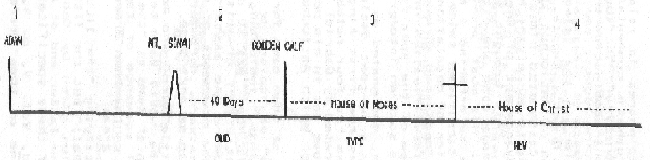
1
. -- Adam -----2. -- Sinai -----3. -- Golden Calf --------4.
-- Cross of Christ -------------
1.
-- God gave to Adam a "commanded" covenant. (Gen.
2:16-17). Obey: -- Live; Disobey: -- Die. Adam broke
the covenant. (Hosea 6:7 margin) Christ stepped in,
and God made a covenant with Him and with man. (Gen.
3:15; Rev. 13:8) This was the New Covenant when ratified
at Calvary. (Heb. 9:12-15)
2.
-- At Mt. Sinai, God entered into a covenant with Israel
which contained no provision for mercy. It was Obey: --
Live; Disobey: -- Die. (Ex. 20:22; 24:8; Note - 23:20-21)
Within forty days Israel broke the covenant. (Ex. 32:1-6)
3.
-- Moses interceded for Israel. (Ex. 32:30-32) God
then made a Covenant with him and with Israel. (Ex. 34:10,
27) Under this Covenant the typical sanctuary functioned.
(Ex. 25:.8-9) The book of Hebrews refers to this
relationship as the house of Moses. (Heb. 3:2-5)
4.
-- All reality finds its end in Christ. He is the Seed of
the woman, the antitype of Moses, the great High Priest,
and Mediator of the New Covenant. Christ is the "Son
over His own house." (Heb. 3:6) TOP
p 80 --
APPENDIX D -- ANTIOCHUS
EPIPHANES and the LITTLE HORN of DANIEL 8
The reason for discussing Antiochus
Epiphanes in relationship to "the little horn"
of Daniel 8
is that most modern prophetic commentators consider
this Seleucid king as the fulfillment of the prophecy of
"the abomination of desolation." ["Transgression
of desolation" (8:13);
"the abomination that maketh desolate" (11:31;
12:11)]
Antiochus Epiphanes was the
eighth ruler in the Seleucid dynasty which arose out of
the divisions of Alexander the Great's Empire. This dynasty
was more or less continuous from 312-65 BC Son of Antiochus
the Great, Antiochus Epiphanes reigned from 175-164 BC He
designated himself as Theos Epiphanes - "God Manifest."
A devotee of Zeus, probably perceiving himself as an incarnation
of this chief deity, he sought the advancement of Greek
culture and religion throughout the regions he controlled.
This brought him into direct conflict with the Jews. He
wrought the most damage upon the city of Jerusalem since
the siege and destruction by Nebuchadnezzar. His most provocative
act toward the Jews was the desecration of the Temple by
offering a pig on the sacred altar, and forcing the people
to eat of the sacrificed swine. In I Maccabees 1:54, it
is stated - "They builded an abomination of desolation
upon the altar." Three years later to the day a new
altar was "dedicated afresh." (4:53-54)
These historical facts form the basis for the identification
of Antiochus Epiphanes as "the little horn" of
Daniel 8.
A review of the specifications of the prophecy and the statement
of Jesus Himself negate such an interpretation.
Daniel
8 begins with a vision of a ram, designated as
"the kings of Media and Persia." (8:3,20)
This is followed by a he-goat declared to be "the king
of Grecia" with the single notable horn "as the
first king." (8:5,21)
The "great horn" is broken, and in its place comes
"up four notable ones toward the four winds of heaven."
(8:8)
This is interpreted by Gabriel to mean that "four kingdoms
shall stand up out of the nation, but not in his power."
(8:22)
The Seleucid dynasty was one of these kingdoms of which
Antiochus Epiphanes was but one of the line - not even the
greatest!
The prophecy continues - "And
out of one of them came forth a little horn."
(8:9)
Whether the "one" refers back to "winds"
of heaven, or to the "horns" involves the linguistics
of verses 8
& 9.
If "winds," indicating location, a significant
case can be made
as to where "the little horn" was to arise; for
the direction of conquest, and thus origin, form a vital
part of this prophecy. The "little horn" was to
move "toward the south, toward the east, and toward
the pleasant land." Directions were also given for
the movements of the ram and the he-goat. (8:4-5)
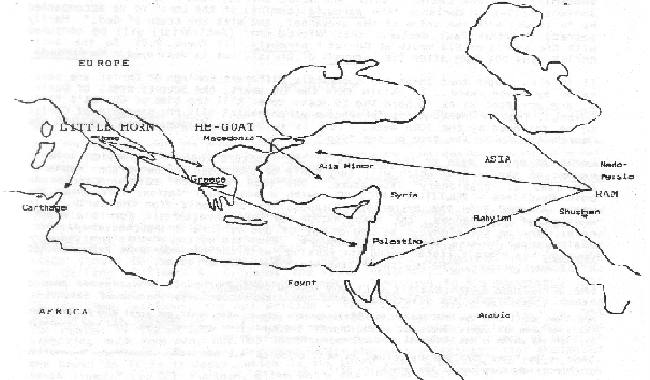
For example, the ram moved westward, northward, and southward.
This means that he came from the east. See map on next page.
Applying
this same reasoning to "the little horn" who moved
south, east and toward the pleasant land, or Palestine,
he would have to originate in the north and west. This leads
to the designation of Rome as "the little horn."
The conquests of Rome followed the directional sequence
of the prophecy. First Rome challenged and conquered Carthage
to the south; then Greece to the east, followed by the conquest
of the Eastern Mediterranean area.
There
are other prophetic criteria identifying "the little
horn." The ram "became great;" the he-goat
"waxed very great;" but the little horn "became
exceeding great." (8:4,8,9) The interpretation
given by Gabriel indicated further, that the little horn
would appear at "the latter end of their [horn's] kingdom."
(8:23) Antiochus Epiphanes meets none of these
specifications.
In
The Historians'
History of the World,
Vol. V, p. 1, is an observation which fits perfectly
this prophecy if the "One of them" refers to the
"horns." It
p
81 -- reads:
"As
a matter of fact, the West [or Greek part of Italy] was
left by the mother country to its own devices. But it presently
became evident that the development that took place was
fraught with consequences of the utmost moment to the Hellenistic
political system. By abstaining from preemptory interference,
while such interference was yet possible, the Macedonian
kingdoms permitted a power to arise in Italy so strong that
in a very short time it proceeded to aim a fatal blow at
their own existence."
Jesus
Christ Himself gives the final word to the question as to
whether "the little horn" of Daniel
8 is Antiochus Epiphanes. He told His disciples
that "the abomination of desolation, spoken of by Daniel
the prophet" was yet future in their
day. (Matthew
24:15.)
DIRECTION
OF CONQUEST IN PROPHECY OF DANIEL 8
 TOP
TOP
p
82 -- APPENDIX
E -- THE
SECRET RAPTURE THEORY
Hal
Lindsay
in his book - The
Late Great Planet Earth - popularized the
teaching of the Secret Rapture. This concept of a secret
coming of Christ for His "elect" prior to the
great tribulation and the appearing of the antichrist is
today "the lifeblood of the electronic church."
A teacher of this theory makes the following explanation
of the term, "rapture." He wrote:
Strange
to say the word itself does not appear in the Bible. The
English word means: "to transport to a state of happiness."
It comes from the Latin word, "rapio, " meaning
"to seize quickly or suddenly" or "to snatch
away."
If
the reader will carefully consider I Thessalonians 4:13-18,
he will Note - that in the day of Christ's sudden coming
for His own, they are to be "caught up"
(verse 17). The Greek word here means precisely "snatch
up suddenly." From this we derive the term "Rapture"
commonly used among premillennial teachers in referring
to the first phase of His second advent. (The Rapture,
pp. 4-5; Quoted in The Secret Rapture and the Antichrist,
p. 11)
To
clothe the theory in the respectability of New Testament
Greek research, its advocates have asserted that there is
a difference between the parousia,
or personal presence of Christ, and the apokalupsis,
or revelation of Christ in His glory. However, the very
text cited to associate the concept of "snatch away
suddenly" with the Latin, "rapio" and hence
the English, "rapture" - 1
Thessalonians 4:15-17 - declares "the parousia
(coming) of the Lord" to be accompanied by "a
shout, with the voice of the archangel, and with the trump
of God." Hardly secret! Further Paul declares
that "Wicked One" (Antichrist) will be consumed
with the spirit of His mouth at Christ's parousia.
(II Thess.
2:8) So the antichrist does not come after the
parousia
of Christ, but is destroyed at his parousia.
It
is also taught that these two supposedly different comings
of Christ are separated by seven years. To obtain this sum
of years, the Seventy Weeks of Daniel
9, are arranged so as to have the 69 weeks cover
till the time of Christ's first Advent. Then is introduced
a "prophetic parenthesis" till the parousia
of Christ to be followed by the 70th week. This is built
upon dispensationalism with the Church Age during the time
of the "Gap."
Great
stress is made of the results of the "rapture"
upon civilization. Newspapers of the variety which will
supposedly be published following the "rapture"
are used as "missionary" literature. One such
"advanced" edition carries in bold headlines -
MULTITUDES MISSING - with a sub-line, "Nations Throughout
the World Alarmed Over the Mysterious Disappearing of People
from the Earth." In writing of occurrences, the imagination
is left unfettered. Terrible wrecks take place on the highways
as the driver of one vehicle is snatched away. Airplanes
crash because the pilot disappears. Even the editor of this
Post Rapture Journal has himself listed among the
missing, with the reminder he had preached his famous sermon,
"The Meeting in the Air," hundreds of times.
The
Scriptures teach plainly only one second coming of Christ
not a two phased event. Jesus told His disciples: - Note
- the time sequence by the use of "then"
-
And
then shall they see the Son of man coming in the clouds
with power and great glory. And then shall He send His angels,
and shall gather together His elect from the four winds,
from the uttermost part of the earth to the uttermost part
of heaven. (Mark. 13:26-27)
(Note
- The "they" that see are defined in Matt.
24:30 as "all the tribes of earth." The meaning
of "elect" was discussed in the Lesson, p. 49.)
p
83 -- E
- 2
The fact is that dividing the second coming of Jesus into
two events was not known in Christian teaching prior to
the early 1800's. There are some advocates, however, of
this theory who hold that certain statements of early church
fathers can be used to sustain its approach to apostolic
origin. One of these men is John Walvoord, who is known
as the "dean" of this teaching. His conclusions
are discredited in a recent publication, The Great Rapture
Hoax, by Dave MacPherson (pp. 338-339). *
The
teaching of the rapture of the "saints" prior
to the great tribulation came by a revelation to a young
Scottish teenager, Margaret Macdonald, in 1830. Through
this revelation or dream, Margaret introduced the "secret"
rapture idea noting that Christ would first be seen by only
Spirit-filled Christians. She indicated that the antichrist
was still in the future, instead of the historic Protestant
designation of the Papacy. From
that beginning in Port Glasgow, Scotland, it was taken and
developed by John Darby and C. I. Scofield into a whole
futuristic schema of last day events.
[
* This book may be obtained from the New Puritan Library,
91 Lytle Road, Fletcher, North Carolina 28732. Another book
by the same author - The Incredible Cover-Up - is
also very enlightening on this subject.]
TOP
p
84 --APPENDIX
F -- AN OVERVIEW
The
teachings of Scripture in regard to the second coming of
Christ use various comparisons. The Son of man is pictured
as coming first to the Ancient of days to receive a kingdom.
(Daniel 7:13-14)
In the book of Revelation when the Lord God omnipotent
exercises His power to re-establish His authority in the
earth, the declaration is made - "the marriage of the
Lamb is come." (Rev.
19:6-7; 11: 15-17) The coming of the Son of man
to the Ancient of days involves a pre-Advent investigative
judgment. This dual representation of Jesus' coming is mingled
by Jesus in a parable He told. Jesus likened the kingdom
of heaven "unto a certain king, which made a marriage
for His son." (Matthew
22:2) When those bidden would not respond, the
festive hall was filled with other guests. Then the king
came in to inspect the guests. (22:11)
If a guest failed to have on the wedding attire supplied
by the king, he was cast out "into outer darkness."
(22:12-13)
While the thrust of the first part of the parable was directed
to the Jewish leadership and how they responded to the coming
of Jesus the first time, the second section involves those
who responded to fill the places of the original Israel.
The robe fitly represents the righteousness of Christ. The
messengers whom God has sent, present to God's second Israel
the robe necessary to come to the marriage supper of the
Lamb.
There
is another parable which Jesus told which should engage
our attention in regard to the marriage of the Lamb. It
is the parable of the Ten Virgins. (Matthew
25:1-13) The setting should be carefully studied.
As the story begins, ten virgins have already responded
to one call to go forth and meet the Bridegroom. They "took
their lamps and went forth (exelthon
from exerchomai)
to meet the bridegroom." (Verse
1) They were all a part of one group - albeit
five were wise and five were foolish. "They all
slumbered and slept" because the Bridegroom tarried.
(Verse 5)
Then at "midnight" a cry was made. (Verse
6) It was the darkest hour, and the voice came
from outside of the virgins. This is what makes this parable
so distinctive from the other marriage parables Jesus told.
The invitations in the other parables were given by servants
of the same kingdom as were the invited guests. Further,
this voice at midnight calls in the same language as the
call which brought them together in the first instance.
The voice
called - "Go ye out to meet Him." (Verse
5) Here the word is exerchesthe from exerchomai,
but in the present tense: - "Be going out to a meeting
of Him." In response to this a separation occurred.
Five responded, while five continued to lean upon the venders
of spiritual merchandise until it was too late - the door
was shut! (Verse
11)
Here
is the same picture as all the other calls - a messenger
with the Lord's message. The tragedy is that there will
be those who will be giving lip service to the messenger
and messengers of the past, but who will miss or reject
the message and messenger of the midnight hour. The concept
of the spiritual gift, which we call the spirit of prophecy,
is much broader as pictured in Scripture than we are prone
to accept. Our limited view may prove very costly in the
light of eternity.
p 85 -- QUIZ ANSWERS
Lesson
#1 -- Section I: 3, 2, 3, 2 -- Section II: T. F. F.
T. F. T.
Lesson
#2 -- (1) Father, Son, Holy Spirit. (2)
form, equal. (3) express, person. Hebrews 1:3. (4)
is. (5) man, things. (6) spirit, truth.
(7) Bible. (8) fruits, ground, word, lamb, offering,
same, worship, truth. (9) man, God. Acts 5:3, 4.
Lesson
#3 -- (1) was, was, was, was, John 1:1-2.
(2) I AM, existent, existent. (3) decree, called,
called. (4) flesh, all, things. (5) Jesus
Christ. (6) Jesus Christ. Neh. 9:12-15; 1 Cor. 10:1-4.
(7) Creator, Saviour, Lawgiver.
Lesson
#4 -- (1) Bible, line, precept, precept. (2)
Sabbath, Lord, God. (3) Lord, Mark 2:27-28. (4)
Friday, Saturday, according, commandment, Sunday. (5)
Friday, sundown Saturday, hour, sacred. (6) cares,
delight, ways, pleasures, words, Lord. (7) flesh,
Sabbath. Isaiah 66:22-23.
Lesson
#5 -- (1) nine, eight, six, resurrection.
(2) command, seventh. (3) fear, Jews, believe.
(4) Acts 20:7, preached, midnight, depart, farewell,
Jerusalem. (5) after, midst, per verse. (6)
vain, commandments. Matthew 15:9.
Lesson #6 -- (1) holy. (2) Ten, Commandments.
(3) Commandments, voice, written, finger. (4) ark,
holy, sanctuary. (5) Moses, Moses, witness (testimony).
(6) land, possession, 4:12-14. (7) Sabbaths,
people, Lord. (8) hearts, mind.
Lesson #7 -- Matching- b. h. d. a. g. j. f. i. e.
c. (1) righteousnesses, filthy, rags, 64:6 (2)
enemies,
reconciled, Son, reconciled, saved, life, 5:10.
Lessons
# 8 & #9 -- (1) consider, sanctuary, pitched,
man. (2) shadow, example, high, once, High, second.
(3) forgiveness, cleansing. (4) one, year, Ezekiel
4:6. (5) time, end, 9:24-26. (6) 457, 483,
Anointed. 27. midst, week, 31, 34, 1844, second, cleansing
(judgment). (7) sin, salvation.
Lesson
#10 -- (1) John 14:3, I will come again. (2)
tribes, see, trump, dead, will, arise, living, righteous,
in, the, air, ever, be, the, Lord. (3) first, resurrection,
1000, years. (4) desolate, being, Satan, dung, buried.
(5) thrones, judgment. (6) New, Jerusalem, fire,
devours, second. (7) all, things, throne, God, servants,
serve.
Lesson
#11-- F. T. T. T. T. F. F. T. F. T. F. T. F. T. T.
Lesson
#12 -- (1) Moses, Christ. (2) God (faith),
commonwealth, Christ. (3) pillar, ground. (4)
homes, upper, written, heaven. (5) baptism, water,
Spirit. (6) death, burial, resurrection. (7)
humility, bread, wine. (8) tithes, holy, tenth, curse,
blessing. (9) meat (food), due, season. (10) Father,
Son. (11) commandments, faith. (12) hear,
voice.
Lesson
#13 -- (1) sanctified, man. (2) truth,
spiritual. (3) loved, hated. (4) tea, coffee,
cola. (5) mice, Isaiah 66:15-17. (6) modesty.
(7) Love, world, world, world, Father. (8) evil.
(9) displaced, person. (10) temple, Spirit.
Lesson #14 -- There
is no Quiz.
End of Bible Study
Guide.
©2001-2025TOP
master